Complete Guide to Delta Air Lines Pilot Pay in 2026: Base, 401k, Profit Sharing, and Total Compensation
Airline pilot compensation looks simple from the outside — a big annual salary number — but the real paycheck is built from several moving parts. Understanding them is the difference between comparing two offers well and comparing them badly.
The base: hourly pay times guarantee
Most people think an airline pilot’s salary is a single, straightforward number. The reality is quite different: the "base salary" you see online is missing 30% to 40% of a Delta pilot's actual compensation. Because of profit sharing, direct 401k contributions, and per diem, a Delta captain's true take-home and retirement package is vastly higher than their hourly wage suggests. If you are evaluating your career progression, the fragmented and often outdated information available online makes decisions harder. Union contracts are dense, marketing materials can be misleading, and understanding the total package requires a spreadsheet. This guide breaks down every component of Delta pilot pay in 2026. We will cover base salary, the 16% direct 401k contribution, profit sharing historical trends, per diem, benefits, and total lifetime earnings across different aircraft categories.
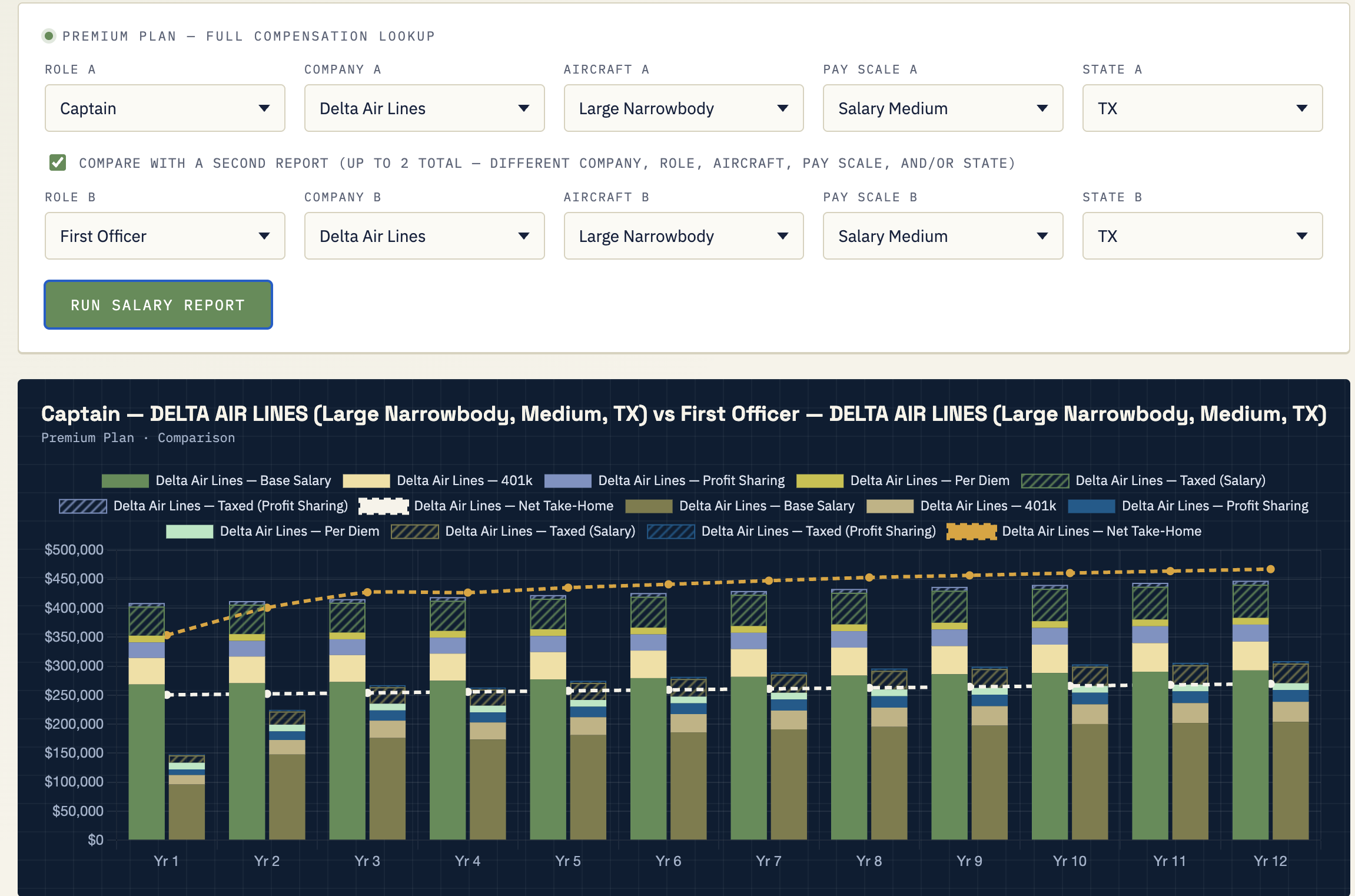
Compare Your Trajectory: You can model your specific career path at Delta and compare it side-by-side with other airlines using our skylevels.fyi comparison tool.
How Delta Pilot Pay Actually Works
Airline pilot compensation is modular. Unlike traditional salaried jobs, Delta pilots operate under a union contract negotiated by the Air Line Pilots Association (ALPA). This contract structure dictates that pay is primarily driven by three factors: your seat (Captain or First Officer), your seniority (years with the company), and the specific aircraft type you fly. Your pay is built on a "guaranteed" minimum number of monthly hours, typically around 65 to 70 hours. However, pilots routinely fly or are credited for 75 to 80+ hours. Your hourly rate is just the foundation. On top of that base pay, Delta adds a massive 16% direct contribution to your 401k (no match required), profit sharing that has historically hovered between 10% and 16%, and untaxed per diem for expenses while on trips. This creates a scenario where a widebody captain might have a base taxable salary of $268,515 in their first year, but actually receives a total compensation package well into the mid-$300k range when factoring in retirement and variable pay.
Base Salary Breakdown
Base pay is entirely dependent on what you fly and how long you have been flying it. Delta categorizes its fleet into different pay bands.
- Widebody: Boeing 787, 777, 767-400, 747, Airbus A350, A330.
- Midsize: Boeing 767-200/300, 757-200/300, Airbus A321neo.
- Large Narrowbody: Boeing 737-900/900ER, 737 MAX.
- Regular Narrowbody: Boeing 737-700/800, Airbus A320 series. Below is a look at the median take-home numbers for a pilot residing in Texas (no state income tax), factoring in standard deductions. Two more pieces move the total meaningfully:
First Officer Pay (Years 1 to 12)
| Aircraft Type | Year 1 Base (After Tax) | Year 5 Base (After Tax) | Year 12 Base (After Tax) |
|---|---|---|---|
| Regular Narrowbody | $81,668 | $145,738 | $163,087 |
| Large Narrowbody | $83,208 | $151,722 | $169,917 |
| Midsize | $81,668 | $153,105 | $172,706 |
| Widebody | $81,668 | $182,832 | $203,018 |
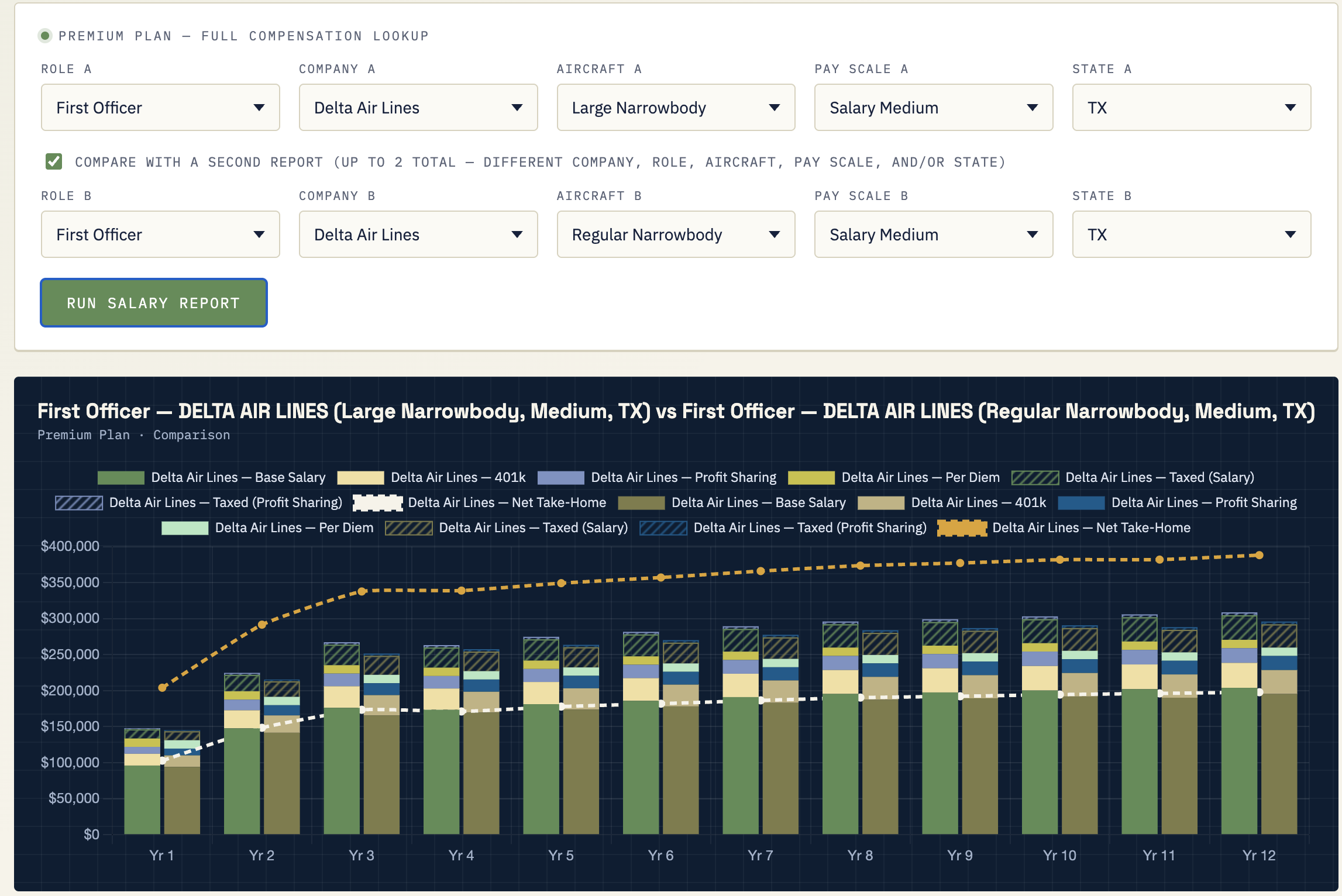 Key Insight: The jump from Year 1 to Year 2 as a First Officer is massive. A Regular Narrowbody FO jumps from $81k after-tax to nearly $120k after-tax in just twelve months.
Captain Pay (Years 1 to 12)
Upgrading to Captain brings a significant pay increase, reflecting the final command authority and responsibility for the aircraft.
| Aircraft Type | Year 1 Base (After Tax) | Year 5 Base (After Tax) | Year 12 Base (After Tax) |
|---|---|---|---|
| Large Narrowbody | $218,210 | $224,543 | $235,556 |
| Midsize | $223,769 | $230,354 | $243,337 |
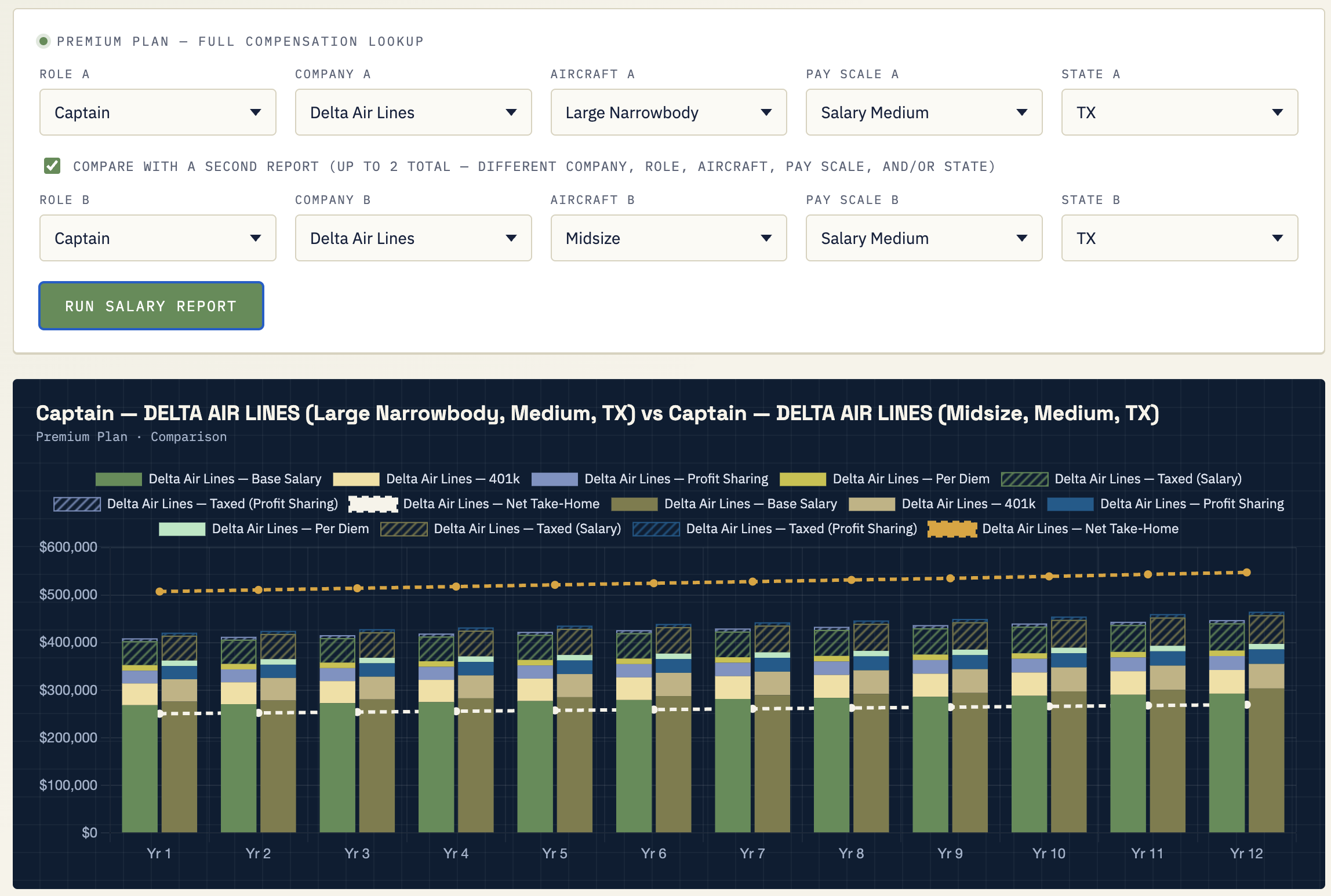
Note: Pre-tax base salaries are significantly higher. For example, a Year 1 Large Narrowbody Captain pays roughly $50,305 in federal taxes on their base salary, making the gross base roughly $268,515.
401k and Profit Sharing
This is where Delta pilot pay truly separates itself from typical corporate salaries.
The 16% Direct Contribution
Delta provides a 16% direct contribution to a pilot's 401k. This is not a match — you do not have to put in a single dollar of your own money to receive this. For a Year 12 Midsize Captain, this equates to $51,626 deposited straight into their retirement account annually. Over a 20-year career, this single benefit often results in multi-million dollar retirement portfolios before market growth is even calculated.
Profit Sharing
Delta's profit-sharing program pays out a percentage of the company's annual profit to employees. While highly variable, a conservative year still yields substantial bonuses.
- Year 5 Widebody FO: ~$17,515 in profit sharing.
- Year 10 Midsize Captain: ~$22,688 in profit sharing.
Per Diem and Additional Pay
Pilots are paid for the time they spend away from base to cover meals and incidentals. In 2026, per diem rates provide a steady stream of untaxed income.
Assuming standard line flying, a pilot can expect to receive around $11,610 annually in per diem, regardless of seat or aircraft type.
Additionally, pilots can earn:
- International Override: Extra hourly pay for flying oceanic routes.
- Premium Pay: Picking up open trips on days off can pay 150% to 200% of the standard hourly rate.
- Training Pay: Compensation during upgrade or transition training.
Benefits Beyond Cash
The cash is excellent, but the soft benefits protect it.
- Health Insurance: Delta offers premium health, dental, and vision coverage at highly subsidized rates.
- Loss of License Insurance: Critical for pilots. If you lose your FAA medical certificate, disability insurance protects a significant portion of your income.
- Travel Benefits: Free standby travel on Delta for the pilot, spouse, dependents, and parents, plus buddy passes for friends.
- Retiree Health Benefits: Crucial for bridging the gap between mandatory retirement (age 65) and Medicare eligibility.
Total Compensation by Career Stage
Let's look at the complete financial picture (Gross Base + 401k + Profit Sharing + Per Diem) for a few distinct career milestones.
Year 1 First Officer (Regular Narrowbody)
- Gross Base: ~$94,138
- 401k: $16,003
- Profit Sharing: $7,911
- Per Diem: $11,610
- Total Compensation: ~$129,662
Year 5 First Officer (Widebody)
- Gross Base: ~$220,343
- 401k: $37,458
- Profit Sharing: $17,515
- Per Diem: $11,610
- Total Compensation: ~$286,926
Year 12 Captain (Midsize)
- Gross Base: ~$303,685
- 401k: $51,626
- Profit Sharing: $23,098
- Per Diem: $11,610
- Total Compensation: ~$389,919
Comprehensive 25-Year Career Projection
To truly understand the value of the Delta contract, you have to look at lifetime earnings. Airline pilot pay scales exponentially, and the 16% direct 401k contribution compounds heavily over two decades. Here is a realistic 25-year career trajectory for a pilot hired in 2026, assuming standard upgrade times and a shift to widebody flying later in the career.
- Years 1-3 (First Officer, Regular Narrowbody): You start building seniority. With base pay, per diem, profit sharing, and 401k, total compensation scales from roughly $130,000 in Year 1 to over $185,000 by Year 3.
- Years 4-7 (First Officer, Widebody): Transitioning to the right seat of an A330 or A350 brings a significant pay bump and international overrides. Total compensation jumps into the $250,000 to $295,000 range annually.
- Years 8-15 (Captain, Large Narrowbody): Upgrading to the left seat of a 737-900ER or A321neo. Your base salary breaks the $220k barrier. With the 16% 401k contribution and profit sharing, your total annual package ranges from $350,000 to over $400,000.
- Years 16-25 (Senior Captain, Widebody): The pinnacle of airline earning. Commanding a flagship widebody aircraft like the A350, total compensation frequently pushes past $450,000, easily exceeding $500,000+ depending on profit sharing and premium flying.
Over a 25-year career, a Delta pilot can expect to earn well over $8.5 to $10 Million in total cumulative compensation, with more than $1.5M of that being purely company-funded retirement contributions.
Delta Career Progression Reality
The numbers look great on paper, but how fast can you actually access them? Upgrading to Captain or transitioning to a widebody aircraft depends entirely on your seniority and base location.
- Base Seniority: Delta operates massive hubs in Atlanta (ATL), Detroit (DTW), Minneapolis (MSP), and Salt Lake City (SLC), alongside coastal hubs like Seattle (SEA), Los Angeles (LAX), and New York (JFK/LGA). A junior base like New York might allow for a Captain upgrade in 2 to 3 years, whereas a highly coveted base like SLC or ATL might take 6 to 8+ years for the same upgrade.
- Upgrade Timelines: In the current post-pandemic hiring environment, narrowbody First Officers are regularly holding Captain slots within 3 to 5 years.
- Widebody Access: Holding a widebody Captain position is generally a late-career milestone, typically requiring 12 to 15+ years of company seniority. However, widebody First Officer positions can often be held within the first 3 to 5 years, unlocking substantial pay early on.
Comparing Delta to Other Airlines
Choosing between legacy carriers or major airlines requires looking closely at contract nuances, base locations, and long-term fleet plans. A difference of a few dollars in an hourly rate can equal hundreds of thousands of dollars over a career.
Delta vs. United Airlines At the top end of the pay scale, Delta and United are incredibly comparable. Both offer the industry-standard 16% 401k direct contribution and operate robust, high-paying widebody fleets on global routes. However, differences emerge in their profit-sharing formulas and historic payouts—Delta has historically paid out larger profit-sharing checks on average over the last decade. Base locations also play a massive role; United pilots might favor hubs like IAH, EWR, or DEN, while Delta pilots are drawn to ATL or DTW. To see the exact differences in earning potential, check out our Delta Air Lines vs United Airlines Pilot Pay comparison.
Delta vs. Southwest Airlines Southwest pilots fly an exclusive fleet of Boeing 737 aircraft, meaning they top out at narrowbody pay rates. While Southwest's hourly rates are excellent for the 737, Delta offers a significant premium for pilots who eventually transition to widebody aircraft like the A350 or A330. While Southwest pilots can sometimes fly more hours to compensate, Delta's widebody captains earn substantially more per hour. Over a 25-year career, the total lifetime earnings at Delta will usually outpace Southwest by a wide margin due to this equipment difference. You can dive into the specific lifetime earnings gap in our Delta Air Lines vs Southwest Airlines Pilot Pay comparison.
Delta vs. Alaska Airlines Similar to Southwest, Alaska Airlines operates a predominantly narrowbody fleet (mostly Boeing 737s and MAX variants). While Alaska's contract is highly competitive for the aircraft they fly, a Delta pilot who upgrades to widebody flying will see a massive divergence in their peak earning years. An Alaska Captain might max out slightly lower than a Delta narrowbody Captain and significantly lower than a Delta widebody Captain. Compare the specific pay bands in our Alaska Airlines vs Delta Air Lines Pilot Pay comparison.
For a wider overview of how these compensation packages sit within the industry, Thrust Flight provides an excellent overview of Delta pilot salaries to supplement your research.
FAQ Section
1. How much does a first-year Delta pilot make? A first-year First Officer can expect a total compensation package (base, benefits, per diem) of roughly $130,000.
2. What's the highest-paying Delta aircraft? Widebody aircraft like the Airbus A350, A330, and Boeing 777 command the highest hourly rates.
3. Do Delta pilots make more than doctors? Yes, frequently. A senior widebody captain at Delta earns total compensation exceeding $500,000 annually, which outpaces the median income for many medical specialties.
4. How does Delta profit sharing work? A percentage of the company's pre-tax income is distributed to employees every February. Over the last decade, this has often represented 10% to 16% of a pilot's eligible earnings.
5. How do state taxes affect a Delta pilot's take-home pay? Because pilots can commute to their base, where you live drastically changes your take-home pay. Living in a state with zero income tax (like Texas, Florida, or Washington) will save a senior Captain $15,000 to $25,000+ annually compared to living in California or New York.
6. What is the typical upgrade path from regional airlines to Delta? Most regional pilots need 1,000 to 2,000 hours of Part 121 turbine time (often achieved as a regional Captain) to be competitive for Delta. Delta also pulls heavily from military aviation and its own Propel program.
7. How does base seniority work? You bid for your aircraft and seat based on your date of hire. If a junior base like NYC has Captain openings, you can upgrade much faster there than you could in a senior base like Atlanta or Salt Lake City.
8. What is the mandatory retirement age? By FAA regulation, all Part 121 airline pilots must retire at age 65. Planning for this hard stop makes the 16% 401k contribution critical.
9. What happens if I lose my medical certificate? Delta offers Loss of License and disability insurance. This protects a significant percentage of your income if you encounter a medical issue that prevents you from holding a First Class Medical certificate.
10. What is a "hiring class" and why does it matter? Your seniority is assigned on day one of your initial hiring class (indoctrination). Being just one or two numbers ahead of someone else in your class can dictate your schedule, base choices, and upgrade timing for the next 25 years.
11. How long to upgrade to Delta captain? Upgrade times vary wildly based on hiring waves, retirements, and aircraft type. Currently, pilots can upgrade to narrowbody captain in as little as 3 to 5 years depending on the base.
Conclusion
The 2026 ALPA contract ensures that Delta Air Lines remains a premier destination for career aviators. While the base salary alone is impressive, the true power of the Delta contract lies in its 16% direct 401k contribution and robust profit-sharing checks. When a mid-career captain is pulling in nearly $400,000 in total compensation, the financial return on the initial investment in flight training becomes incredibly clear.
Career decisions require the full picture. Never look at just an hourly rate.
Model your Delta career at skylevels.fyi. Compare Delta to your current airline's total compensation and see exactly what your lifetime earnings will look like across the industry.