How Much Does a First-Year Delta Pilot Actually Make?
If you are planning your aviation career, you want straight numbers, not marketing fluff. You might have seen the hourly rate and wondered: how much does a first-year Delta pilot actually make in 2026? The direct answer is that a first-year First Officer at Delta earns approximately $155,000 to $200,000 in total compensation.
While the advertised base pay for a new hire hovers around $95,000 to $110,000, that number represents only a fraction of your real earnings. When you factor in the company’s massive 16% direct 401k contribution, partial profit-sharing eligibility, un-taxed per diem, and comprehensive health benefits, your actual take-home package expands significantly. In this guide, we break down your exact first-year compensation by every pay component, explore what affects your monthly check, and compare Delta’s starting package to other major airlines.
The Real First-Year Numbers
To understand your first year of pay, you must look beyond the hourly rate. Airline compensation is highly modular, and base pay is only the foundation of your earnings.
Your baseline is the ~$118 hourly rate designated for a Year 1 First Officer. This base rate applies uniformly regardless of the aircraft type you are assigned to—whether you are placed in the right seat of a Regular Narrowbody like the Airbus A220, a Large Narrowbody like the Boeing 737-900ER, a Midsize like the Boeing 757, or a Widebody like the Airbus A350.
You are guaranteed a minimum of 72 hours per month if you are on reserve status, but most line-holding pilots credit significantly more. Assuming a conservative schedule, your gross annual base pay will land between $94,138 and $110,000 depending on your exact block hours and premium pick-ups.
But that is just the start. Here is how your total compensation actually stacks up in year one:
- Annual base pay: ~$95,000 - $110,000
- Profit sharing (year 1 partial): +$8,000 - $15,000
- Per diem: +$10,000 - $18,000
- 401k contribution (16%): +$15,000 - $18,000
- Benefits value (health, travel, disability): +$25,000 - $35,000
- TOTAL COMPENSATION: $155,000 - $200,000
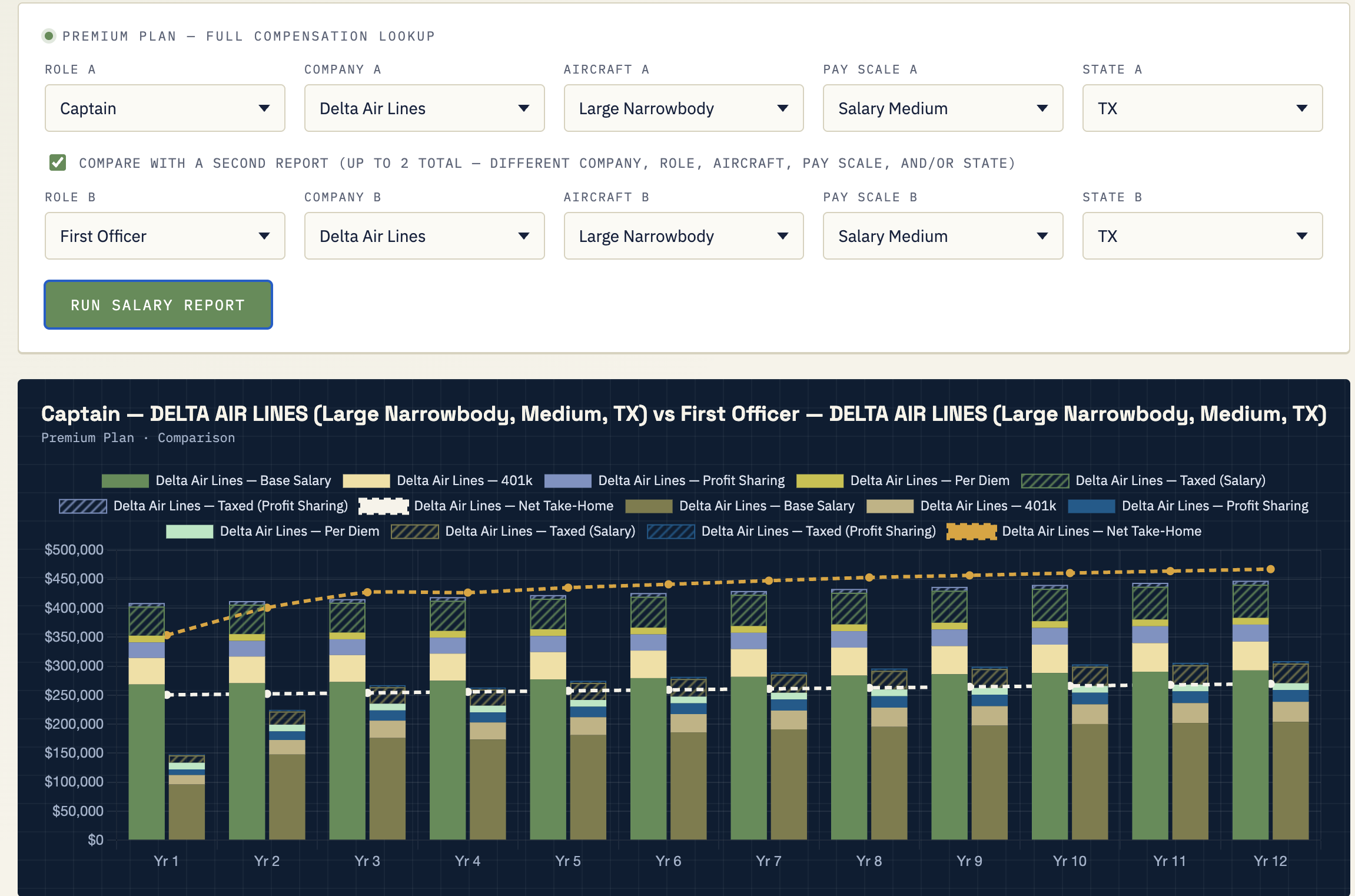
Below is a breakdown of median numbers for a First Officer flying a Large Narrowbody, assuming standard deductions and residence in a tax-free state like Texas:
| Compensation Component | Estimated Annual Value | Description |
|---|---|---|
| Gross Base Pay | $105,000 | Based on average monthly flight credits. |
| After-Tax Base (TX) | $83,208 | Net cash after standard federal tax deductions. |
| 16% Direct 401k | $16,324 | Automatic company contribution; no match required. |
| Profit Sharing | $8,058 | Varies based on company performance and hire date. |
| Per Diem | $11,610 | Un-taxed cash for meals and incidentals while flying. |
Bottom Line: Your base salary is roughly $105,000, but your total first-year economic value realistically pushes closer to $160,000 when you include retirement and per diem.
How This Compares to Other Airlines
How does this roughly $160k total cash package stack up against the competition? Due to recent union negotiations, the first-year pay across the legacy carriers is highly competitive, but nuances in profit sharing and retirement structures create long-term differences.
Delta vs. United Airlines
First-year compensation between these two carriers is nearly identical at the top level. United offers the same hourly starting rate and the identical 16% direct 401k contribution. The primary difference for a new hire will be your base location preferences and Delta's historically stronger profit-sharing payouts. To see the exact long-term differences, compare Delta Air Lines vs United Airlines Pilot Pay..
Delta vs. American Airlines
American Airlines recently instituted contractual "snap-up" provisions to match their competitors, meaning your year-one hourly rate will be almost exactly the same. American is highly competitive on year-one pay, but base options like Dallas and Miami might heavily influence your decision depending on where you want to live. Dive into the details in our American Airlines vs Delta Air Lines Pilot Pay guide.
Delta vs. Southwest Airlines
Southwest pilots fly the Boeing 737 exclusively. A first-year First Officer at Southwest makes a comparable starting base of roughly $105,000, but Southwest utilizes a 20% employer 401k match rather than a direct contribution. This means you must contribute a significant portion of your own base pay to unlock the full retirement value. Explore the lifetime earnings gap in our Delta Air Lines vs Southwest Airlines Pilot Pay analysis.
Delta vs. Cargo Carriers
Historically, flying heavy cargo jets paid more than flying passengers. That is no longer true for new hires. A first-year First Officer at FedEx Express earns roughly $81 per hour—significantly less than Delta's starting rate. Similarly, a first-year UPS First Officer earns a much lower initial base near $59,770. See how the numbers have shifted in our comparisons of Delta Air Lines vs FedEx Express Pilot Pay and Delta Air Lines vs UPS Airlines Pilot Pay.
What Affects Your Actual First-Year Pay
While the first-year hourly rate is fixed by the ALPA contract, your actual W-2 at the end of the year can fluctuate by tens of thousands of dollars based on a few operational realities.
First, consider your base assignment. Delta operates massive hubs in Atlanta, Detroit, Minneapolis, and Salt Lake City, alongside coastal hubs like New York, Seattle, and Los Angeles. If you are assigned to a junior base that is understaffed, you might find yourself flying more block hours than a pilot sitting at a highly senior base.
Your status as a line holder versus a reserve pilot also dictates your income. Reserve pilots are guaranteed a minimum of 72 hours per month, meaning even if you sit at home and never get called to fly, you get paid for those 72 hours. If you hold a regular line (a set schedule of trips), you will likely credit closer to 75 or 85 hours a month, bumping your gross pay up substantially.
Furthermore, if you want to hustle, you can volunteer to pick up open trips on your days off. Delta frequently offers premium pay for these open trips during busy travel seasons or weather events, sometimes paying 150% to 200% of your standard hourly rate. An aggressive first-year pilot who capitalizes on premium flying can easily push their base pay past $130,000 before benefits are even calculated. Finally, if you are assigned to a Widebody aircraft, you can earn an International Override of $4.50 per hour for oceanic flying, which slightly boosts your overall yield.
How Fast Your Pay Grows
Your first year at Delta is essentially an introductory rate. The true power of an airline contract kicks in on your one-year anniversary.
Once you hit Year 2, your pay is no longer a flat uniform rate. It scales dynamically based on the specific aircraft you fly. Because of this, the jump from Year 1 to Year 2 is the largest single-year percentage raise you will likely ever receive in your career.
- Year 2 FO: Depending on whether you fly a Regular Narrowbody or a Widebody, your base salary will immediately jump to roughly $120,000 to $150,000.
- Year 5 FO: By your fifth year, widebody First Officers are frequently earning base salaries between $180,000 and $220,000, with their 401k direct contributions easily topping $30,000 annually.
- Year 8+ Captain Eligible: When you hold the seniority to upgrade to the left seat as a Captain, your base salary will skyrocket past $280,000, with top widebody Captains eventually making over $465,000 annually at the top of the pay scale.
The long-term trajectory is incredibly lucrative, making that $155,000 first-year package look like just a stepping stone in retrospect. For a deep dive into your potential earnings at year 5, 10, and 20, read our Complete Guide to Delta Air Lines Pilot Pay in 2026 or explore deeper insights at Thrust Flight's Delta salary overview.
FAQ Section
Do I get profit sharing my first year? Yes, but it is prorated. Delta's profit sharing is distributed every February based on the company’s performance in the previous calendar year. You will only receive a payout based on the eligible earnings you generated during the specific months you were actually employed in that year.
What's the minimum guaranteed hours? As a new hire on reserve, you are guaranteed pay for 72 hours per month minimum, up to a maximum of 80 hours depending on the month's Average Line Value (ALV). Even if you fly zero hours, you receive that base level of compensation.
How does per diem work? You are paid an hourly un-taxed rate for every hour you are away from your base. For domestic trips, this is approximately $2.85 per hour, and for international trips, it is $3.30 per hour. It is designed to cover meals and incidentals, but most pilots pocket a large portion of it as extra income.
Can I bid for more hours? Absolutely. Once you hold a regular schedule (a line), you can pick up additional trips through the open time system. During operational shortages, these extra trips can pay out at highly lucrative premium rates.
Is the 401k match automatic? Delta does not use a standard "match." They provide a 16% direct contribution. The company automatically deposits an amount equal to 16% of your eligible earnings directly into your 401k, whether you contribute your own personal money or not.
Conclusion
A realistic total compensation package for a first-year Delta pilot is between $155,000 and $200,000. While your hourly rate dictates a base salary around $105,000, your un-taxed per diem, partial profit sharing, and Delta's massive 16% direct 401k contribution add immense financial value to your first year on the line.
Remember, your starting base pay is just one piece of the puzzle. The real wealth in aviation is built through seniority, equipment upgrades, and retirement compounding over a 25-year career.
See your first year at Delta modeled at skylevels.fyi.