Complete Guide to American Airlines Pilot Pay in 2026
American Airlines widebody captains earn $417,937 total compensation at Year 12 for Texas residents. That's less than United's $466,700 but more than Delta's $383,526. The APA contract structure creates specific advantages and disadvantages Delta and United pilots don't face. Here's exactly what American pays.
You make a permanent career decision the moment you accept a class date at a legacy carrier. Your seniority number locks you in. You can't jump ship without resetting your pay scale back to zero. You must understand exactly how your chosen airline compensates you over a thirty-year timeline before you sign that contract.
American Airlines operates the largest commercial fleet on the planet. They dominate massive swaths of the domestic sunbelt and control highly lucrative international gateways. The recent contract cycles forced the legacy carriers to match each other's hourly rates, but total compensation varies wildly based on retirement structures, union rules, and fleet composition.
We pulled the exact, tax-adjusted data from the skylevels.fyi database to expose the real numbers. This analysis strips away the noise and looks purely at your take-home pay, your 401k deposits, and your per diem as a Texas resident. We will break down the exact earning power of American Airlines so you can map out your financial trajectory with absolute certainty.
Model Your Career: Don't guess with your lifetime earnings. Map out your exact timeline using the skylevels.fyi comparison tools to see how your specific scenario stacks up against the rest of the industry.
How American Pay Works: APA vs ALPA
American Airlines pilots operate under a completely different union structure than their legacy peers. The Allied Pilots Association (APA) represents the aviators at American. Delta and United pilots operate under the Air Line Pilots Association (ALPA). This distinction matters heavily for your day-to-day quality of life and your paycheck.
The APA acts as an independent union. They negotiate aggressively for specific work rules, trip trading flexibility, and reserve systems that differ fundamentally from the ALPA models. When you fly for American, you navigate the APA's proprietary scheduling software and reserve call-out metrics.
During the historic 2023-2024 contract cycles, the APA secured a massive victory for its pilots. They negotiated a powerful "snap-up" provision. This clause guaranteed that if United or Delta negotiated higher hourly rates, American Airlines would automatically increase their pay rates to match the competition. This provision forced pure base pay parity across the Big Three legacy carriers.
Your base pay at American relies on an hourly rate multiplied by your monthly credited flight hours. You receive a minimum monthly guarantee, ensuring a stable paycheck even if weather systems or maintenance issues cancel your flights. However, smart pilots at American manipulate the APA trip trading system to drop trips, pick up premium open time, and maximize their W-2 cash flow.
You trade the massive ALPA national resources for a fiercely independent, highly localized union. The APA prioritizes high guaranteed base rates and massive direct 401k contributions. They focus on hard cash hitting your bank account right now. You can see how this strategy matches up against the ALPA heavyweights by looking at our American Airlines vs Delta Air Lines Pilot Pay and American Airlines vs United Airlines Pilot Pay comparison tools.
Base Salary Breakdown Year-by-Year
Let's look at the actual cash. We modeled these numbers for a pilot residing in a tax-free state like Texas. This isolates the sheer earning power of the APA contract by removing state income tax variables. You see exactly what you keep after the federal government takes its cut.
Your pay depends on your seat, your years of service, and your aircraft size. American categorizes its fleet into Large Narrowbody (like the Airbus A321 and Boeing 737) and Widebody (like the Boeing 777 and 787 Dreamliner).
First Officer Progression
You enter American Airlines on a uniform Year 1 pay scale. Whether you sit in the right seat of a 737 or a 777, you take home the exact same base salary.
- Year 1 FO (All Fleets): $99,892 net base salary (after paying $16,158 in federal taxes).
Your pay explodes in Year 2. The rates diverge based on your assigned aircraft, and your earning power effectively doubles.
- Year 2 Large Narrowbody FO: $149,876 net base salary.
- Year 5 Large Narrowbody FO: $182,260 net base salary.
- Year 12 Large Narrowbody FO: $203,763 net base salary (after paying $42,707 in federal taxes).
If you secure a widebody right seat, you access massive heavy metal premiums.
- Year 2 Widebody FO: $184,128 net base salary.
- Year 5 Widebody FO: $222,196 net base salary.
- Year 12 Widebody FO: $246,914 net base salary (after paying $58,586 in federal taxes).
A senior First Officer flying widebody aircraft at American clears nearly a quarter-million dollars in pure net cash. You out-earn almost every regional captain in the country while avoiding the stress of command.
Captain Progression
Upgrading to the left seat unlocks the highest tax brackets in aviation.
- Year 1 Large Narrowbody Captain: $264,924 net base salary (after paying $66,086 in federal taxes).
- Year 5 Large Narrowbody Captain: $272,464 net base salary.
- Year 12 Large Narrowbody Captain: $285,991 net base salary.
The ultimate prize remains the widebody Captain seat. You fly the flagship routes to London, Tokyo, and Buenos Aires. You earn the absolute peak of the APA contract.
- Year 1 Widebody Captain: $320,952 net base salary (after paying $89,418 in federal taxes).
- Year 5 Widebody Captain: $330,426 net base salary.
- Year 12 Widebody Captain: $339,887 net base salary (after paying $97,303 in federal taxes).
You take home nearly $340,000 in liquid cash after surrendering $97,000 to the IRS. You dictate your lifestyle, fund your personal investments, and live with absolute financial freedom.
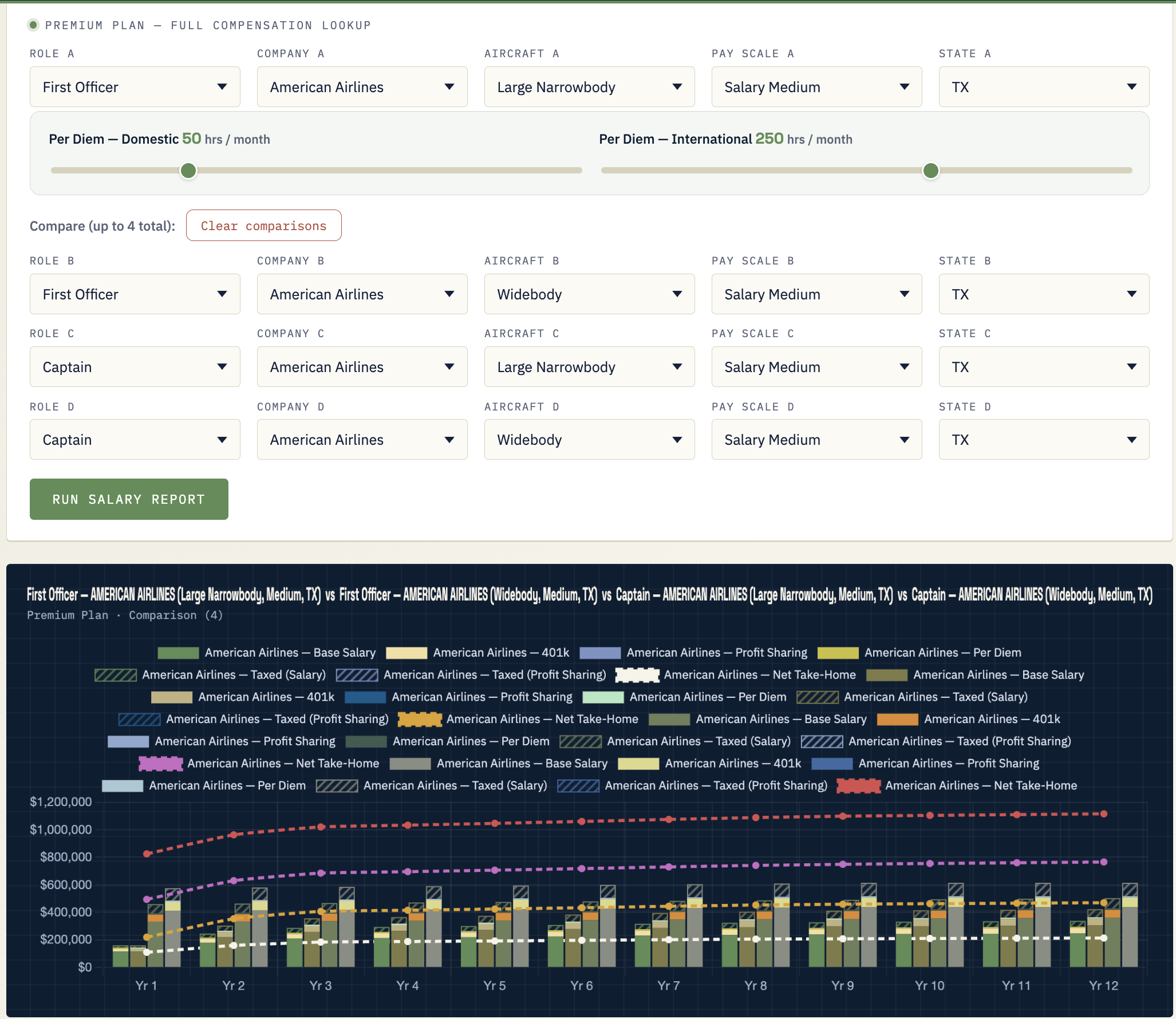
401k and Retirement
You don't build true generational wealth with your W-2. You build it with your 401k.
American Airlines structured its retirement package to rival any company on earth. They utilize a defined contribution model. The company drops massive cash directly into your retirement account every single month. They don't require you to match a single dollar. You receive the money automatically.
The numbers stagger anyone outside of the legacy aviation sector. Look at the direct deposits hitting the accounts of American Airlines pilots across different career stages:
- Year 1 FO (Narrowbody): $18,568
- Year 5 FO (Narrowbody): $35,042
- Year 12 FO (Widebody): $48,880
- Year 1 Capt (Widebody): $65,659
- Year 12 Capt (Widebody): $69,950
A senior widebody captain at American receives nearly $70,000 a year in pure retirement capital. Over a 20-year career as a captain, that direct contribution alone generates $1.4 million in raw cash. When you factor in standard stock market compound interest, that portfolio effortlessly scales into the high seven figures.
The data in our model shows $0 for profit sharing. American relies heavily on its massive base rates and immense 401k contributions to deliver wealth, rather than leaning on the variable, unpredictable profit-sharing checks you see at other carriers. You secure guaranteed money instead of risking your W-2 on quarterly corporate earnings.
If you want to see how this 401k accumulation compares to a defined benefit pension, you need to look at the cargo operators. Run your numbers through the American Airlines vs FedEx Express Pilot Pay and American Airlines vs UPS Airlines Pilot Pay tools. You must choose between the massive 401k deposits of the passenger world and the fixed retirement income of the cargo giants.
Per Diem and Variable Pay
You spend hundreds of hours sitting in hotel rooms away from your family. American Airlines compensates you for that time through untaxed per diem.
Per diem acts as a silent wealth multiplier. Because the IRS doesn't tax this expense reimbursement, every dollar stretches significantly further than your base salary. Based on standard flight schedules, our median Texas model shows American pilots generating roughly $9,780 in annual per diem. (While specific lower-utilization widebody models sit around $8,100, the median pilot pulls closer to $10,000).
When you fly international widebody routes, you generate per diem rapidly. You sit on a layover in Rome or Sydney for 48 hours, accumulating hourly untaxed cash the entire time you explore the city.
You also boost your W-2 through variable premium pay. When the operation runs short on pilots during holiday surges or severe weather events, American offers premium multipliers for pilots willing to pick up open trips on their days off. Aggressive pilots weaponize this system. They bid for minimum schedules, drop their low-paying trips, and scoop up premium flying at 150% or 200% of their standard hourly rate. A motivated narrowbody captain can easily push their total compensation into widebody territory by hustling the trip trade system.
Base City Options: DFW, CLT, PHL, MIA
Your base assignment dictates your quality of life more than any other factor in aviation. If you commute to work by sitting in jumpseats on your days off, you destroy your mental health and exhaust your body. You choose an airline that places a base in the city you actually want to live in.
American Airlines commands massive geographical dominance across the Sunbelt and the East Coast.
- Dallas/Fort Worth (DFW): The operational heart of the airline. DFW acts as the ultimate superhub, offering endless route variety, fast upgrades, and massive premium trip availability. If you live in Texas, American stands as the undisputed king.
- Charlotte (CLT): A massive, highly efficient narrowbody hub dominating East Coast traffic.
- Miami (MIA): The undisputed gateway to Latin America and the Caribbean. If you live in South Florida, MIA provides incredible international flying without the brutal oceanic time zone changes.
- Philadelphia (PHL) & New York (JFK/LGA): Critical Northeast hubs providing deep transatlantic access to Europe.
If you live in Dallas, Charlotte, or Miami, American Airlines offers a destination career you can't pass up. If you live on the West Coast, you face a tougher reality. While American operates a hub in Los Angeles (LAX), it pales in comparison to their central operations. West Coast pilots must carefully weigh their options. Check out the Alaska Airlines vs American Airlines Pilot Pay comparison to see how the premier West Coast LCC measures up against the American legacy network.
Career Progression
You build your career at American Airlines by managing your seniority.
Most pilots arrive at American with thousands of hours of regional airline experience. They transition into the right seat of an Airbus A320 or Boeing 737. They spend a few years learning the APA contract, mastering the massive route network, and building mainline seniority.
Upgrade times fluctuate based on aircraft deliveries and mandatory age-65 retirements. You control your destiny. You can choose to upgrade to a narrowbody captain seat quickly by bidding for a junior base like New York. You accept the pain of commuting to secure the massive $264,000 net base salary.
Alternatively, you can choose quality of life. You stay in the right seat of a widebody aircraft in your home base of Dallas. You clear $246,000 as a senior First Officer, hold every weekend off, and avoid the stress of command entirely. The sheer size of the American Airlines fleet allows you to tailor your career path exactly to your family's needs.
If you currently grind away at a regional airline, you need to pull the trigger on your transition. See the exact mathematical cost of your delay using our American Airlines vs Envoy Air Pilot Pay and American Airlines vs SkyWest Airlines Pilot Pay models.
American vs Peer Comparison
The 2026 aviation market presents you with incredible choices. American Airlines locks you into a massive $417,000+ total compensation package at the top end. But you must verify how that stacks up against the competitors who want your talent.
American vs LCC Majors
Carriers like JetBlue and Southwest operate incredibly lucrative narrowbody networks. They frequently match legacy narrowbody pay, but they can't offer the massive $417,000 widebody total compensation because they simply don't fly heavy metal. See the exact differences in our American Airlines vs JetBlue Airways Pilot Pay and American Airlines vs Southwest Airlines Pilot Pay breakdowns.
American vs Legacy Rivals
United Airlines boasts a slightly higher total compensation package at the top end due to their massive 17% 401k deposits. Delta Air Lines relies on heavy profit-sharing checks to boost their W-2s. American splits the difference, leaning heavily on high base rates and immense 401k drops without the variable profit-sharing risk. Review the American Airlines vs United Airlines Pilot Pay guide to finalize your legacy carrier decision.
FAQ
Why does the American Airlines data show zero profit sharing? The APA contract prioritizes heavy guaranteed base rates and massive direct 401k contributions over variable profit sharing. While American has paid out profit sharing historically, our baseline data models it at zero to isolate your guaranteed, contractually obligated cash flow. You don't risk your wealth on corporate earnings reports.
Is commuting to an American base difficult? Commuting ruins your quality of life. While American operates massive hubs, you must bid carefully to ensure you can hold a base near your home. The APA contract provides some commuter protections, but sitting in jumpseats on your days off destroys your physical health over a 25-year career. Live in base.
How long does it take to reach widebody captain pay? You reach widebody captain status through sheer seniority. Depending on hiring waves and retirements, pilots typically secure widebody captain slots after 12 to 15 years on the property. However, aggressive pilots who bid for junior bases can sometimes accelerate this timeline.
Does Envoy flow directly to American? Yes. Envoy Air acts as a wholly-owned regional subsidiary for American Airlines. They operate a direct flow-through agreement. However, relying on a flow agreement traps you. You surrender control of your timeline to corporate staffing metrics. Aggressive pilots apply off the street rather than waiting years for their flow number to get called.
The Bottom Line
American Airlines offers a bulletproof path to generational wealth. A Year 12 Widebody Captain taking home a $339,887 net base salary, receiving $69,950 in pure 401k contributions, and generating nearly $10,000 in untaxed per diem commands elite financial power.
You choose American Airlines for its massive network dominance, its sunbelt superhubs, and its heavy reliance on guaranteed cash over variable bonuses. You trade the ALPA national structure for the fierce independence of the APA. You secure a career that effortlessly bridges the gap between massive domestic flying and heavy international prestige.
Don't guess with your future. Secure your wealth by planning your next move meticulously. Dive into our complete Career Bundle for advanced interview prep, and use the interactive skylevels.fyi comparison tools to map out your exact timeline today. Your seniority number is waiting.