JetBlue vs Alaska Airlines: The LCC Major Comparison
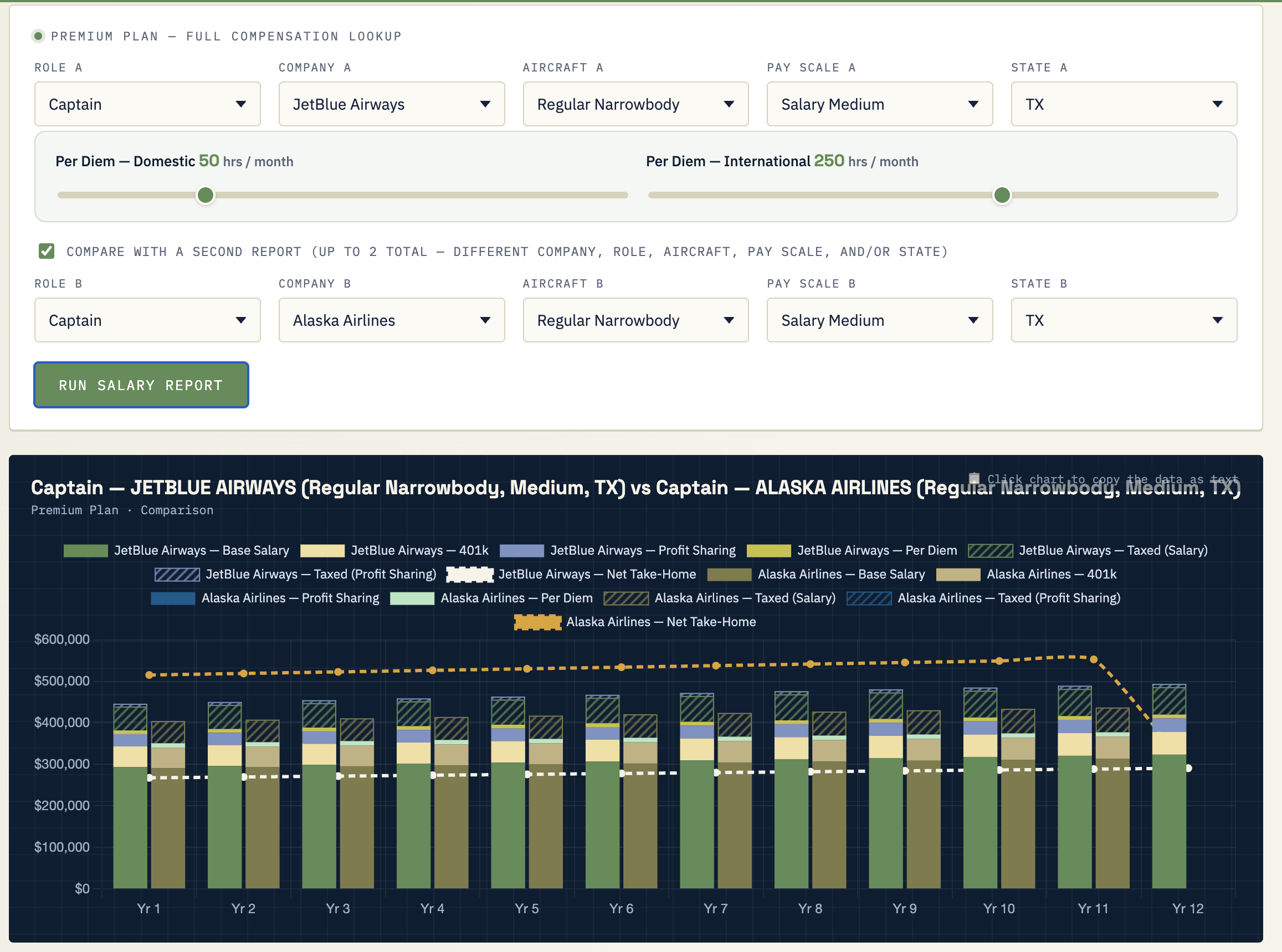
JetBlue captains earn $344,264 at year 12. Alaska captains earn $315,570 at year 11. The $28,694 annual gap tells only part of the story. JetBlue's profit sharing ($24,383 at Year 12) explains most of the difference. Here's the complete analysis of both major LCC carriers.
You face a massive decision when you transition out of the regional airlines. You stare at conditional job offers from JetBlue Airways and Alaska Airlines. Both operate as heavyweight low-cost carriers (LCCs) that punch far above their weight class. They offer compensation packages that rival legacy giants, making them highly coveted destination careers. You do not treat these airlines as stepping stones. You retire here.
But choosing between them requires you to look hard at the math. A $28,694 annual difference in total compensation alters your lifetime wealth trajectory. You must break down exactly how these two carriers structure your W-2. One carrier relies heavily on variable profit sharing to pad your bank account. The other carrier builds its value strictly through base hourly rates and solid per diem generation.
We pulled the exact net take-home pay for regular narrowbody captains living in a tax-free state like Texas. We isolated the federal tax deductions to show you the raw cash you actually get to spend. Use this data to map out your career. See exactly how these LCCs compare to the broader market by reading our Best Regional Airlines and LCCs for Pilots breakdown.
Base Pay Head-to-Head
Your base salary acts as the foundation of your aviation wealth. If you fly for a major LCC, you expect a base rate that competes directly with Delta, United, and American. Both JetBlue and Alaska deliver on that expectation.
Let's strip away the bonuses and the 401k matches. We will look strictly at the net base salary—the cash hitting your checking account after the IRS takes its cut.
When you upgrade to the left seat, Alaska Airlines hands you an immediate financial advantage. A Year 1 Captain flying a regular narrowbody at Alaska nets $237,132 in base pay. A Year 1 Captain at JetBlue nets $236,097. Alaska wins the early game by just over a thousand dollars.
By Year 5, the two carriers reach a dead heat. A Year 5 Captain at Alaska takes home $243,751. A Year 5 Captain at JetBlue takes home $243,738. The difference drops to a negligible thirteen dollars. You earn the exact same base cash flow regardless of which uniform you wear.
The scales finally tip in JetBlue's favor as you approach the top of the seniority list. A Year 8 JetBlue Captain clears $249,570. The equivalent Alaska Captain clears $248,717.
At the absolute peak of this data set, JetBlue pulls ahead permanently. A Year 12 JetBlue Captain nets $257,364 in pure base salary. Because the Alaska pay scale in our specific data tops out at Year 11, we compare that to the Year 11 Alaska Captain, who nets $253,567.
Net Base Salary Comparison (Texas Resident)
| Career Stage | JetBlue Net Base Salary | Alaska Net Base Salary | Winner |
|---|---|---|---|
| Year 1 Captain | $236,097 | $237,132 | Alaska |
| Year 5 Captain | $243,738 | $243,751 | Tie |
| Year 8 Captain | $249,570 | $248,717 | JetBlue |
| Year 12/11 Captain | $257,364 | $253,567 | JetBlue |
JetBlue holds the ultimate base pay advantage, but the margins remain razor-thin. Over a decade of flying, the base salary differences alone will not dictate your career choice. You must look at how these carriers compare to the legacy giants if you want to see massive base pay gaps. Compare the Alaska numbers directly against American Airlines in our Alaska Airlines vs American Airlines Pilot Pay tool, or stack them against Delta using the Alaska Airlines vs Delta Air Lines Pilot Pay breakdown.
If you currently fly for a regional carrier, you need to realize exactly how much base pay you forfeit every single month you delay your transition. See the brutal math in our Alaska Airlines vs SkyWest Airlines Pilot Pay and Alaska Airlines vs Envoy Air Pilot Pay comparisons.
The Profit Sharing Difference
Base pay creates a tie. Profit sharing destroys it.
The entire $28,694 gap in total compensation at the top of the pay scale exists because JetBlue writes a massive profit-sharing check. Alaska Airlines provides exactly $0 in profit sharing based on this contractual data.
When you reach Year 12 as a JetBlue Captain, the company distributes $24,383 in profit sharing directly to you. That represents a massive cash infusion that hits your bank account annually. Even at Year 1, JetBlue hands its junior captains $22,434 in profit-sharing payouts. You get immediate, powerful W-2 expansion the moment you take the left seat.
Why does this difference exist? Airlines choose how they distribute their wealth during union negotiations. JetBlue structured their contract to reward pilots aggressively when the company performs well. They use profit sharing as a massive retention tool, ensuring you stay invested in the airline's operational success.
Alaska Airlines rolls their pilot compensation entirely into hard hourly rates and retirement contributions. They offer a highly predictable W-2. You know exactly what you will earn every single month. You do not worry about corporate earnings calls or quarterly revenue drops. If Alaska misses its financial targets, your paycheck remains perfectly intact.
You must decide your risk tolerance. JetBlue offers a higher absolute ceiling through variable cash bonuses. Alaska guarantees a slightly lower total package but removes the corporate performance risk from your W-2. If you want to see how this dynamic plays out against another highly profitable LCC, review our Alaska Airlines vs Southwest Airlines Pilot Pay analysis.
401k Comparison
You do not build generational wealth by spending your W-2. You build it through your 401k.
Both JetBlue and Alaska abandoned the old defined benefit pension models. They rely entirely on massive defined contribution 401k plans. They dump heavy cash into your retirement account every single year, requiring zero investment risk on the company's part.
The two carriers operate nearly identical retirement structures. They mirror each other step for step. A Year 1 Captain at JetBlue receives $49,892 in direct 401k deposits. A Year 1 Captain at Alaska receives $49,442. The difference equals less than five hundred dollars.
As you progress through your career, the retirement accounts scale simultaneously. A Year 5 JetBlue Captain sees $51,723 deposited into their 401k. A Year 5 Alaska Captain sees $50,974.
At the absolute top of the scale, the Year 12 JetBlue Captain receives a $54,987 company contribution. The Year 11 Alaska Captain receives $53,273.
You secure over fifty thousand dollars a year in tax-advantaged retirement wealth at either airline. You gain massive market exposure. You control your investments. Both carriers offer highly competitive retirement packages that easily outpace any regional airline in the world.
If you want to see how these massive 401k deposits stack up against the legacy defined benefit pensions, you need to read our cargo analyses. Look at the Alaska Airlines vs FedEx Express Pilot Pay and Alaska Airlines vs UPS Airlines Pilot Pay data to understand the difference between a 401k and a true cargo pension.
Per Diem and Extras
You spend hundreds of hours away from your family every single month. The airlines compensate you for that time through untaxed per diem.
Alaska Airlines edges out JetBlue in this specific category. A standard Alaska Captain generates $8,730 in per diem annually. A JetBlue Captain generates $7,530.
Alaska wins this metric by $1,200. Because per diem flows to you completely untaxed, its real economic value stretches further than standard W-2 cash. It covers your meals on the road and pads your checking account.
Beyond per diem, both airlines offer robust soft benefits. You receive highly subsidized health, dental, and vision insurance. You gain access to vital Loss of License insurance that protects your six-figure income if your FAA medical certificate gets pulled. You also receive industry-standard standby travel benefits for your family.
Neither airline dominates the benefits category. They both provide the standard protections required by modern aviation professionals. If you want to see how these benefits compare to the ultimate legacy carrier standard, run the numbers in our Alaska Airlines vs United Airlines Pilot Pay tool.
Base Cities and Lifestyle
You ruin a great paycheck if you commute. Your airline choice must revolve around your home address.
Alaska Airlines owns the Pacific Northwest. If you live in Seattle, Portland, or Anchorage, Alaska offers the ultimate quality of life. You drive to work, fly your trips, and sleep in your own bed. They operate a highly efficient network that dominates West Coast travel.
JetBlue Airways anchors its massive operation on the East Coast. They run superhubs in New York (JFK) and Boston (BOS), with a massive footprint in Fort Lauderdale. If you live in the Northeast corridor or South Florida, JetBlue hands you an incredible lifestyle advantage.
You must factor cost of living into your calculations. Living in base at JFK or Seattle requires a massive real estate budget. Your $344,000 JetBlue salary shrinks rapidly when you pay New York property taxes. Choose the airline that places a base in the city you actually want to live in. See exactly how JetBlue stacks up against Alaska in our direct Alaska Airlines vs JetBlue Airways Pilot Pay comparison.
FAQ Section
Which pays more overall? JetBlue pays more overall. A Year 12 JetBlue Captain generates $344,264 in total compensation compared to $315,570 for a Year 11 Alaska Captain. JetBlue's profit sharing creates the gap.
Are either of these airlines better for widebody progression? Neither airline operates widebody aircraft in this specific data set. They both rely on massive, highly efficient narrowbody fleets (Boeing 737s for Alaska, Airbus A320/A220s for JetBlue). If you demand widebody flying, you must look at legacy passenger carriers or heavy cargo operators.
Which airline has a better schedule? Your schedule depends entirely on your seniority in your assigned base. A senior captain in Seattle enjoys an incredible schedule at Alaska. A junior reserve captain commuting to JFK hates their life at JetBlue. Pick the airline where you can live in base.