Corporate Aviation vs Airlines: The NetJets Reality
NetJets captains earn $339,500 in total compensation at year 12 flying business jets. That competes directly with LCC majors like JetBlue, where captains earn $344,264 at year 12. But NetJets pilots work half the days of airline pilots. Corporate aviation quietly became the smartest financial choice for pilots who value time. Here's the complete analysis.
Most pilots operate under a massive misconception. You believe the only path to generational wealth runs through legacy airlines or major low-cost carriers. You assume corporate aviation represents a career compromise or a permanent pay cut.
The raw data exposes that lie entirely.
NetJets captains earn elite compensation packages while working drastically fewer days than their commercial airline peers. While passenger airline pilots fight for union contracts and navigate chaotic hub airports, NetJets quietly structured a compensation system that rivals the highest tiers of Part 121 aviation. We isolated the specific numbers for NetJets business jet captains and compared them directly to the brutal reality of airline schedules.
If you value your time off, corporate aviation stands as the smartest financial decision you can make. The industry shifted aggressively over the last few years. You no longer have to sacrifice your W-2 to enjoy a predictable life. We will break down the exact dollar amounts, examine the staggering 401k contributions, and show you exactly why seasoned airline pilots increasingly abandon the passenger terminals for the private aviation sector.
NetJets Compensation Reality
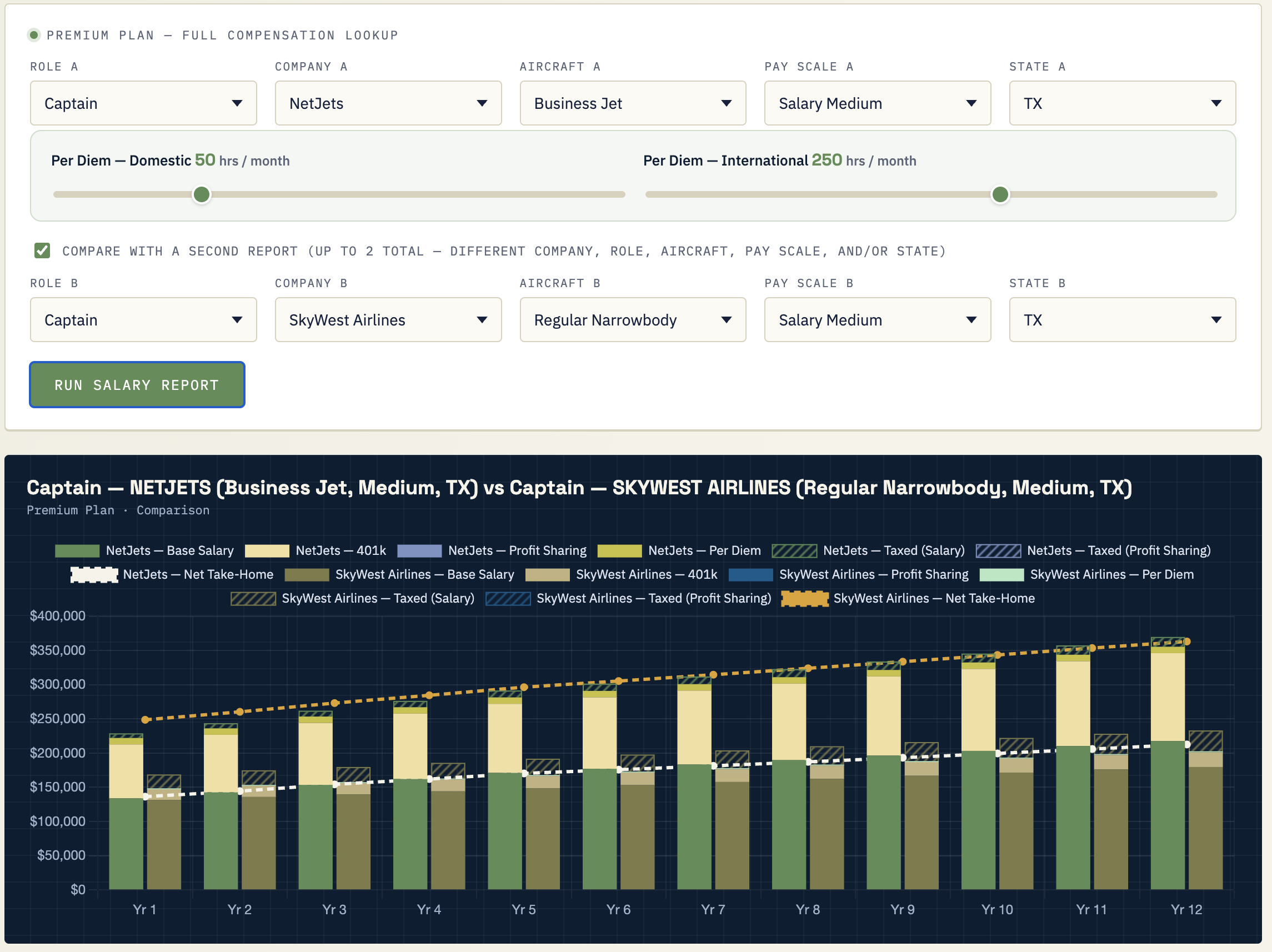
Look at the exact dollars hitting your account. We modeled a NetJets Captain flying business jets, residing in Texas to eliminate state tax variables and expose pure federal net income. You skip the grueling regional jet poverty years entirely.
Here is the year-by-year progression:
- Year 1: $213,673 total ($127,006 net base + $78,933 401k + $7,734 per diem)
- Year 5: $269,633 total ($160,952 net base + $100,947 401k + $7,734 per diem)
- Year 8: $297,531 total ($177,875 net base + $111,922 401k + $7,734 per diem)
- Year 12: $339,500 total ($203,334 net base + $128,432 401k + $7,734 per diem)
You break the $200,000 threshold in your very first year on the property. A regional pilot at SkyWest grinds for an entire decade just to touch $172,031. You blow past the $300,000 barrier before a decade passes at NetJets.
The base salary acts as a formidable foundation. A Year 12 NetJets Captain clears $203,334 in pure net cash after the IRS takes its massive cut. This cash flow allows you to dictate your lifestyle immediately. You don't wait until your 50s to achieve financial independence.
The regional airline trap looks pathetic compared to this progression. You lose hundreds of thousands of dollars every year you delay your transition to a heavy hitter. Map out the exact financial damage of staying at a regional using our Alaska Airlines vs SkyWest Airlines Pilot Pay and American Airlines vs SkyWest Airlines Pilot Pay comparisons. NetJets offers a massive, immediate upgrade from the regional tier.
The Schedule Advantage
Airlines run you ragged. You bid for days off, suffer through constant schedule changes, and spend massive chunks of your life sitting in crowded passenger terminals waiting for maintenance delays. Your seniority dictates whether you see your family on Thanksgiving or Christmas.
NetJets operates on a rigid 7-on-7-off schedule. You work precisely 183 days a year.
Half the year belongs entirely to you. You know your exact days off months in advance. You never miss a birthday or an anniversary unless it falls on your week to work. When you log off, the company leaves you alone. Airline pilots routinely work 250 days a year to maximize their W-2 through premium pay and open time pickups. They sacrifice their health and their marriages to hit the highest tax brackets.
NetJets hands you top-tier wealth while returning your life to you. Working 183 days a year changes your entire psychological baseline. You recover from jet lag. You pursue outside businesses. You actually raise your children. The value of an airline schedule relies entirely on your seniority. A junior airline captain suffers through terrible reserve blocks. A junior NetJets captain works their seven days and goes home.
NetJets vs LCC Major
Let's stack NetJets directly against a top-tier low-cost carrier like JetBlue.
A Year 12 JetBlue Captain pulls down $344,264 in total compensation. A Year 12 NetJets Captain earns $339,500. The JetBlue pilot earns a negligible $4,764 more per year.
Now look at the hourly reality. The JetBlue pilot grinds out roughly 250 days on the road, battling weather delays, unruly passengers, and chaotic hubs. They deal with union disputes and profit-sharing volatility. The NetJets pilot earns virtually the same compensation while working just 183 days.
Calculate the per-day earning rate. The NetJets pilot earns roughly $1,855 for every day they work. The JetBlue pilot earns roughly $1,377 per day. You trade a tiny $4,764 annual pay gap for two solid months of your life back.
If you want to see how the regional airlines bleed your time for zero wealth, look at the JetBlue Airways vs SkyWest Airlines Pilot Pay tool. NetJets crushes the LCC market when you factor your actual time into the equation.
The 401k Difference
NetJets structured its wealth building differently than any other company in aviation. Look at the Year 12 401k contribution: $128,432.
That represents the highest direct retirement contribution in the entire industry. Legacy carriers like United and Delta cap their direct 401k deposits around $60,000 to $82,000 based on IRS limits and specific spillover mechanics. NetJets unleashes a tidal wave of corporate capital into your retirement portfolio.
You secure millions in long-term wealth without touching your massive base salary. If you invest $128,432 annually into the market over a 15-year window, the compound interest creates an eight-figure retirement portfolio. You achieve absolute financial freedom.
Compare this retirement structure against the broader airline market. See how NetJets destroys the regional model by checking SkyWest Airlines vs United Airlines Pilot Pay and Delta Air Lines vs SkyWest Airlines Pilot Pay. Regional airlines simply can't compete with this level of institutional investment. Even top-tier cargo operators struggle to match a pure $128,432 annual cash deposit.
Career Considerations
Corporate aviation demands a unique mindset. You fly sophisticated business jets into exclusive private terminals. You cater to high-net-worth clients who expect flawless execution and absolute discretion.
You manage the entire client experience. You act as the captain, the flight attendant, and the concierge. It requires exceptional customer service skills alongside your stick-and-rudder proficiency. You never deal with TSA lines. You pull up to the FBO, load the bags, brief your client, and fly.
If you fly for a regional airline right now, you need an escape plan. Evaluate your cargo options through the FedEx Express vs SkyWest Airlines Pilot Pay or SkyWest Airlines vs UPS Airlines Pilot Pay metrics. Look at the legacy transition via Envoy Air vs SkyWest Airlines Pilot Pay or SkyWest Airlines vs Southwest Airlines Pilot Pay. If the commercial grind exhausts you, NetJets offers the ultimate sanctuary.
FAQ
Is NetJets actually better than the airlines?
Yes, if you value a fixed schedule and guaranteed days off over sheer W-2 cash at a legacy carrier. You trade the massive passenger airline profit-sharing checks for unprecedented retirement contributions and a stable lifestyle.
What is the schedule reality?
You work seven days on, seven days off. You know your life months in advance. You never sit on reserve wondering if crew scheduling will destroy your weekend.
Can I switch from the airlines to NetJets?
Yes. NetJets aggressively recruits seasoned Part 121 aviators who want their lives back. Many airline pilots willingly trade their legacy seniority numbers for the 7-on-7-off corporate schedule to escape the grueling passenger terminal commute.