Regional vs Major Airline: The $7 Million Career Decision
A career at SkyWest as a year 12 captain earns $172,031 annually. The same year at United as a widebody captain earns $466,700. That is a $294,669 annual gap—or $7.3 million over a 25-year career. Most regional pilots don't calculate this correctly. Here's the honest analysis of both paths.
You sit in the left seat of an Embraer 175. You hold weekends off. You know the gate agents, you like your schedule, and that $172,031 W-2 feels like a massive victory compared to your days as a flight instructor. You tell yourself that quality of life beats chasing a seniority number at a major airline.
You lie to yourself.
Comfort acts as a financial poison in aviation. The market split violently following the 2023 contract cycles. Major legacy carriers established pay scales that completely dwarf the regional sector. Pilots grinding away at regional airlines fundamentally misunderstand exactly how much money they forfeit every single month they delay their transition.
We pulled the exact, tax-adjusted data from the skylevels.fyi database to expose the brutal math. We strip away the crew room rumors and compare a career at the premier regional carrier, SkyWest Airlines, directly against the legacy giants. Your first airline job dictates your initial trajectory, but your final destination airline dictates your generational wealth. Let's break down the actual earning power of these two paths so you can navigate your career with absolute precision.
The Compensation Reality
You can't compare a regional vs major airline pilot on an hourly basis. You must look at total compensation. That includes your net base salary, 401k company contributions, profit sharing, and untaxed per diem.
Let's look at the hard data for a pilot residing in a tax-free state like Texas.
A First Officer at SkyWest earns a total package of $84,366 in Year 1. That consists of a $72,948 net base salary, a $10,068 company 401k contribution, and $1,350 in per diem. If that First Officer fails to upgrade and sits in the right seat until Year 8, they cap out at $97,885.
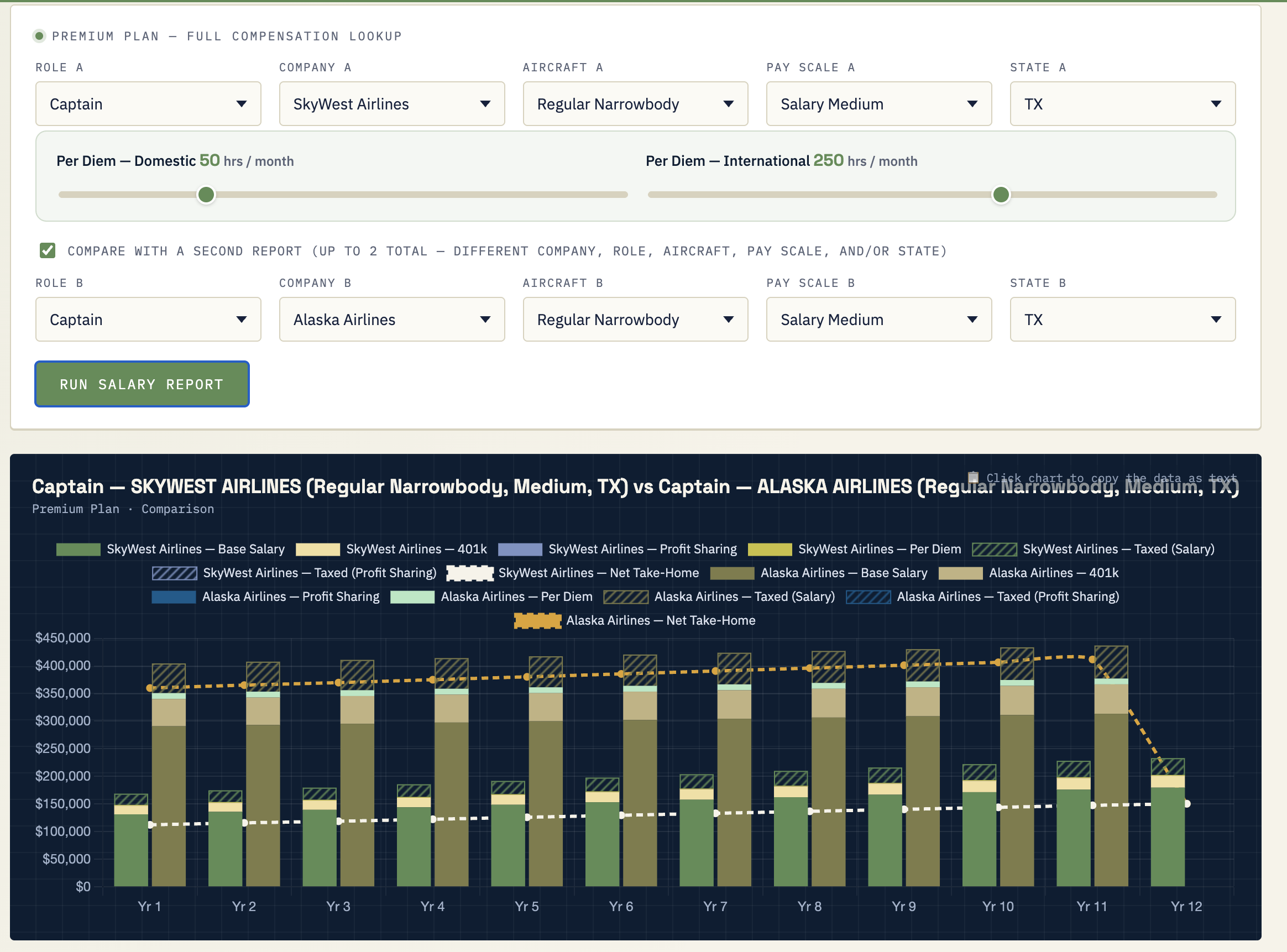
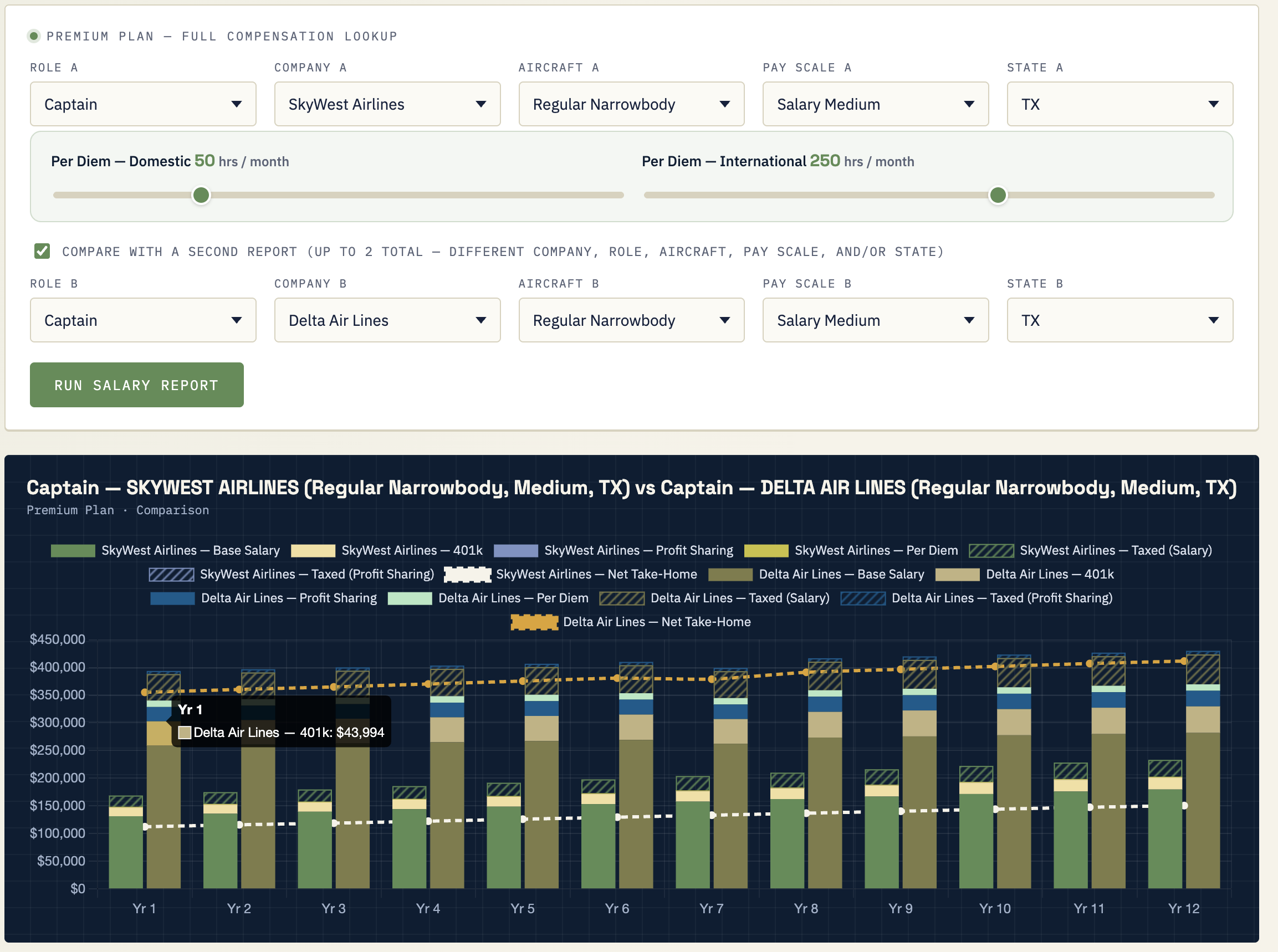
Upgrading to Captain provides immediate relief. A Year 1 SkyWest Captain nets $110,994 in base pay, plus $15,759 in 401k deposits. By Year 12, a SkyWest Captain reaches the absolute peak of the regional pay scale. They take home $149,121 in net base pay, receive $21,560 in 401k deposits, and generate $1,350 in per diem. Their total annual package equals $172,031.
Now look at the major carriers.
| Career Stage | Total Annual Compensation | Airline Type |
|---|---|---|
| SkyWest Year 12 Capt | $172,031 | Regional |
| Alaska Year 11 Capt | $315,570 | LCC Major |
| Delta Year 12 WB Capt | $383,526 | Legacy Major |
| United Year 12 WB Capt | $466,700 | Legacy Major |
The gap defies logic. A Year 12 United Widebody Captain clears $466,700. A Delta Widebody Captain takes home $383,526. Even stepping sideways into a major low-cost carrier like Alaska yields $315,570.
If you sit at a regional airline for 25 years, you might peak around $180,000 to $200,000 annually as scales adjust slightly for inflation. If you transition to a major carrier, you spend decades earning between $300,000 and $500,000.
See the exact annual cost of your complacency by running your numbers through our SkyWest Airlines vs United Airlines Pilot Pay and Delta Air Lines vs SkyWest Airlines Pilot Pay comparison tools. The math remains ruthless. You leave millions on the table.
Where the $7M Actually Comes From
You don't lose $7.3 million simply because the hourly rate differs. The legacy contracts attack wealth building from multiple angles.
First, consider the 401k contribution differences. SkyWest provides a respectable retirement match for a regional airline, yielding $21,560 for a senior captain. United Airlines drops 17% of a pilot's eligible earnings directly into their 401k without requiring a match. For a senior widebody captain, that 17% equates to massive annual deposits. United frequently drops over $82,000 a year into a senior pilot's retirement account.
You lose $60,000 in pure investment capital every single year you stay at a regional. Over 15 years, that $60,000 annual gap compounds in the stock market into millions of dollars of lost retirement wealth.
Second, consider the widebody premium. Regional airlines fly regional jets. You max out your pay flying a 76-seat Embraer or Bombardier aircraft. Major airlines fly heavy metal. When you secure the left seat of a Boeing 777 or an Airbus A350, your hourly rate skyrockets based on the sheer size and revenue capacity of the aircraft. A regional pilot hits a structural financial wall. A major pilot rides equipment upgrades to the highest tax brackets in the country.
If you want to see how this narrowbody limitation hurts you against other carriers, look at our American Airlines vs SkyWest Airlines Pilot Pay breakdown. Even flying narrowbody aircraft at a major legacy carrier completely obliterates the top regional pay scales.
Career Trajectory Comparison
Your career timeline moves much faster than you think. You need a highly aggressive strategy.
The Regional Path Timeline
You hire on at SkyWest. You spend two years in the right seat making $75,000 to $80,000. You upgrade to Captain. You see your pay jump to $128,000. You stay for another ten years because you hold holidays off and avoid commuting. You cap out at $172,031. You fly the exact same domestic routes to the exact same small-town airports until you reach the FAA mandatory retirement age of 65.
The Major Path Timeline
You hire on at SkyWest. You spend one year in the right seat. You upgrade the second you meet the Part 121 minimums. You build 1,000 hours of Pilot-in-Command (PIC) time immediately. At Year 4, you accept a class date at a legacy carrier.
You spend your first few years at the major carrier as a First Officer, taking home $150,000 to $200,000. You upgrade to a narrowbody Captain and clear $300,000. By Year 15 of your total career (Year 11 at the major), you hold a widebody Captain seat. You cross the $400,000 threshold. You fly international routes to Tokyo, London, and Sydney.
You dictate your career flexibility. If you grow tired of flying heavy international schedules, you bid down to a senior narrowbody Captain seat, hold every weekend off, and still make twice as much as the most senior regional captain in the country.
If you prefer the predictable domestic grind over international widebody flying, you should target the major LCCs. Run your numbers through the JetBlue Airways vs SkyWest Airlines Pilot Pay and SkyWest Airlines vs Southwest Airlines Pilot Pay tools. You secure mainline wealth without crossing oceans.
Quality of Life Reality
Regional captains defend their career choices using one metric: quality of life. They claim the major airlines ruin your schedule and destroy your family life.
They operate on outdated information.
Regional airlines fly brutal schedules. You operate four to five legs a day. You battle weather in small aircraft. You fly into uncontrolled airfields with minimal support. You spend your layovers in cheap hotels near interstate highways.
Major airlines fly highly efficient schedules. A widebody captain might fly three trips a month. You operate one leg a day. You cross an ocean, go to sleep in a five-star hotel in a global capital, and fly back three days later. You work half the days of a regional pilot for triple the pay.
Base cities dictate your actual quality of life. If you live in a SkyWest base like Fresno or Boise, jumping to a major might require a commute. That represents a valid concern. However, major airlines operate massive global hubs. If you live near Dallas, Chicago, Atlanta, or Seattle, transitioning to a legacy carrier gives you an instant base assignment in your home city. Check out the Alaska Airlines vs SkyWest Airlines Pilot Pay data to see how West Coast pilots maximize their schedules.
Travel benefits also scale massively. Regional pilots receive standby privileges on their mainline partners, but they sit at a lower boarding priority than the mainline employees. When you work for the major carrier, you hold the highest priority. Your family actually gets on the airplane.
When to Leave Your Regional
You leave the regional airline the exact second a major carrier offers you a class date.
You don't wait for your longevity bonus to pay out. You don't wait for your favorite month to take vacation. You drop everything and take the seniority number. Seniority controls everything in Part 121 aviation. It dictates your pay scale, your schedule, your base assignment, and your seat.
If you delay your transition by one year to finish out a comfortable regional captain bid, you forfeit an entire year of major airline seniority. You permanently trap yourself behind thousands of pilots who took the job before you. That delay costs you millions over a full career.
You optimize your timing by keeping your logbook updated weekly. You attend job fairs. You prep for interviews before you get the invitation. If you want to fly heavy freight, you study the FedEx Express vs SkyWest Airlines Pilot Pay and SkyWest Airlines vs UPS Airlines Pilot Pay metrics right now. Don't wait for the market to tell you you're ready. You force the market to hire you.
The Senior Regional Trap
The industry calls them "lifers." Senior regional captains who stayed too long.
They fall into the trap because the initial pay cut terrifies them. If you make $172,031 as a Year 12 SkyWest Captain, dropping down to a Year 1 First Officer at a major airline feels like a massive step backward. You hate the idea of sitting reserve. You hate the idea of giving up your command.
You suffer from extreme short-term thinking.
You trade thirty years of massive, compounding wealth for two years of comfort. The career cost of delayed decisions ruins your retirement. You miss the widebody upgrade windows. You miss the massive 17% 401k deposits.
If you currently sit in the left seat of a regional jet, you must execute a recovery strategy immediately. Update your applications on all the major portals today. Don't let another wave of 25-year-old First Officers grab mainline seniority numbers ahead of you. If you fly for a wholly-owned regional, map out your flow-through agreement immediately using the Envoy Air vs SkyWest Airlines Pilot Pay comparison. If your flow takes too long, apply off the street to competitors.
FAQ
What is a realistic salary progression from regional to major? You start at roughly $84,000 as a regional First Officer. You upgrade to regional Captain and hit $128,000. You transition to a major carrier Year 1 First Officer and clear $110,000 to $130,000. By Year 5 at the major, you break $200,000. By Year 12 as a widebody Captain, you clear $380,000 to $460,000 depending on the carrier.
When should I apply to the major airlines? You apply the moment you meet the unrestricted Airline Transport Pilot (ATP) requirements and hold competitive Part 121 turbine time. Don't wait for PIC time if the majors are actively hiring First Officers.
Is regional captain seniority worth waiting for? No. Regional seniority is fool's gold. It makes your schedule comfortable today while destroying your financial security tomorrow. You trade millions in future wealth for the ability to hold weekends off in a regional jet.
What about family considerations and commuting? Commuting destroys your mental health. If transitioning to a major carrier forces a cross-country commute, you must carefully calculate the toll on your family. However, the $200,000+ annual raise usually provides enough capital to relocate your family directly to your new major airline base.
The Bottom Line
A $172,031 salary at SkyWest tricks you into complacency. The brutal, unforgiving math of the 2026 aviation market proves that staying at a regional airline costs you over $7.3 million in lifetime W-2 cash and retirement contributions.
You must treat your regional airline exactly as it treats you: as a temporary capacity provider. Get your hours. Secure your turbine time. Then, aggressively target a legacy or major LCC carrier.
Every month you delay your transition costs you thousands of dollars in unrecoverable 401k matches and base pay premiums. Take control of your career today. Dive into our complete Career Bundle to access advanced interview prep and run your exact career numbers through the interactive tools at skylevels.fyi. Your seniority number is waiting.