Complete Guide to UPS Pilot Pay in 2026
UPS widebody captains earn $288,000 to $304,000 in total compensation depending on their seniority. That total sits higher than FedEx, but falls $150,000 short of United Airlines. The Independent Pilots Association (IPA) contract structure explains exactly why this gap exists—and why many aviators eagerly choose to fly for UPS anyway.
If you want to understand your exact earning potential at United Parcel Service, you must look past the legacy passenger carrier models. UPS operates under a completely different union, flies a unique global network, and structures pilot wealth in ways that often confuse outsiders. You will not find the massive profit-sharing checks of Delta here. You will not see the massive 17% direct 401k contributions of United.
Instead, UPS pays massive guaranteed base salaries. A Year 12 widebody captain clears over $286,233 in net take-home base pay alone. We broke down the hard data to show you exactly how the math works, from your low-earning training year straight through to your senior captain upgrade.
How UPS Pilot Pay Actually Works
The Independent Pilots Association (IPA) represents the aviators at UPS. Because UPS pilots do not fall under the Air Line Pilots Association (ALPA) umbrella like Delta, United, or FedEx, their contract reads differently. The IPA negotiates aggressively for high guaranteed base rates rather than relying heavily on variable bonuses or massive 401k matches.
Your compensation at UPS breaks down into three distinct buckets: your base hourly rate, your benefits package, and your variable pay (like per diem and overtime). The base rate acts as the primary wealth engine. When the legacy passenger carriers scored massive 40% raises in 2023, they disrupted the entire aviation market. UPS maintained its ground by offering staggering base salaries that keep immediate cash flow incredibly high for senior pilots.
When you fly for UPS, you fly heavy metal. You do not spend a decade grinding out low pay on regional jets. The UPS fleet consists entirely of widebody aircraft—like the Boeing 747-8F, Boeing 767, Airbus A300, and MD-11. This means you access widebody pay scales almost immediately after you finish your initial training.
Compare the total package side-by-side using our Cargo vs Passenger pilot pay analysis to see exactly how this base-heavy approach stacks up against the rest of the industry.
Base Salary Breakdown
Let's look at the actual cash hitting your bank account. We modeled these numbers for a pilot living in a tax-free state like Texas to isolate the pure earning power of the UPS contract after federal taxes.
The most jarring number on the UPS pay scale is Year 1. Whether you hire on as a First Officer or a Captain, Year 1 operates as a training year. You will earn a flat net base salary of just $52,040. Do not let this number scare you away. Once you cross into Year 2, your pay explodes.
Here is the exact progression for a UPS Widebody Captain:
- Year 2: $271,320 net base salary
- Year 5: $273,725 net base salary
- Year 8: $276,640 net base salary
- Year 12: $286,233 net base salary
First Officers see a similarly massive jump after their probationary training year. A Year 2 Widebody First Officer nets $179,341 in base pay. By Year 12, that First Officer clears $213,799 in net base salary.
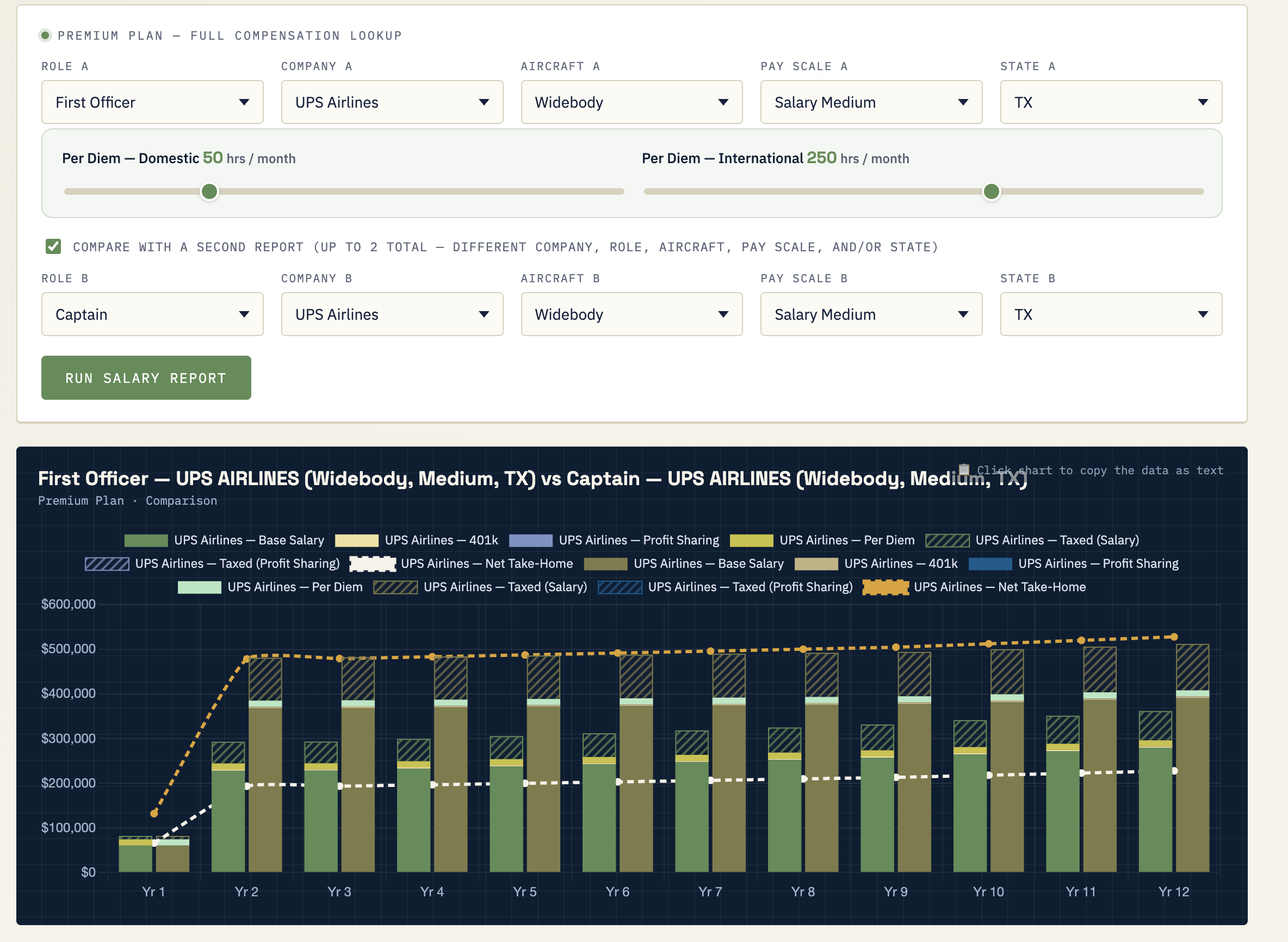
UPS Widebody Pay Progression (Texas Resident Net Pay)
| Career Stage | Net Base Salary | Federal Tax Withheld | 401k Contribution | Per Diem |
|---|---|---|---|---|
| Year 1 FO | $52,040 | $7,730 | $598 | $11,490 |
| Year 5 FO | $185,859 | $51,721 | $2,376 | $11,490 |
| Year 12 FO | $213,799 | $65,571 | $2,794 | $11,490 |
| Year 1 Capt | $52,040 | $7,730 | $598 | $11,490 |
| Year 5 Capt | $273,725 | $97,345 | $3,711 | $11,490 |
| Year 12 Capt | $286,233 | $103,977 | $3,902 | $11,490 |
The data reveals a critical reality about the UPS contract. The pay scales flatten out significantly after the massive Year 2 jump. A captain gains roughly $15,000 in net base pay between Year 2 and Year 12. You secure your wealth early, but you do not see the massive year-over-year percentage gains that define the ALPA passenger contracts.
See how this specific progression compares to other carriers in our Delta Air Lines vs UPS Airlines Pilot Pay and United Airlines vs UPS Airlines Pilot Pay tools.
The 401k Reality at UPS
You must understand the UPS retirement structure before you accept a job offer. If you look at the raw data, the 401k numbers look shockingly low. A Year 12 Widebody Captain earning a gross salary approaching $400,000 only receives $3,902 in 401k contributions. A Year 5 First Officer sees just $2,376.
Why is the UPS 401k contribution so low? The legacy passenger carriers pump 16% to 17% of a pilot's eligible earnings directly into their 401k. United drops over $60,000 a year into a senior captain's account. UPS does not follow this defined contribution model.
The IPA contract historically prioritizes the traditional defined benefit pension plan. Similar to FedEx, UPS offers a pension that guarantees a fixed monthly payout at retirement. The nominal 401k amounts you see in the data represent a very small, supplemental direct contribution. Because UPS funds a massive pension program in the background, they do not match or directly contribute high percentages to the 401k.
You must fund your own investment accounts out of your massive base pay if you want market exposure. If you prefer the passenger carrier model where the company aggressively funds your 401k, you should run your numbers through our JetBlue Airways vs UPS Airlines Pilot Pay or American Airlines vs UPS Airlines Pilot Pay calculators.
Per Diem Advantage
Cargo pilots spend significant time away from home. When you fly heavy freight across the Pacific, you sit in hotels waiting for the next wave of boxes to arrive. UPS compensates you for every hour you spend away from base through untaxed per diem.
UPS pilots consistently generate $11,490 in annual per diem on a standard schedule. This untaxed cash flows directly into your pocket, completely bypassing federal and state tax brackets. When you compare this to passenger carriers, the numbers hold their own. Delta pilots average roughly $11,610, and United pilots average $12,090.
Because cargo routings often involve multi-day global layovers, aggressive pilots who bid for high-credit international lines can push their per diem yield even higher. This untaxed money essentially covers all your meals and expenses on the road, leaving your entire base salary intact for wealth building.
Benefits Package
UPS provides a benefits package built to protect your family and your FAA medical certificate. When your career relies entirely on your physical health, soft benefits matter just as much as the hourly rate.
- Health Insurance: UPS offers premium medical, dental, and vision coverage. The IPA negotiates hard to keep pilot out-of-pocket maximums and premiums incredibly low.
- Life and Disability Insurance: If you lose your medical certificate, your income vanishes. UPS provides aggressive Loss of License and long-term disability insurance to protect a massive portion of your six-figure salary if you can no longer fly.
- Travel Benefits: Cargo airlines do not sell passenger tickets. You do not get the robust standby travel network that Delta or United pilots enjoy. However, UPS participates in jumpseat agreements and offers limited reciprocal travel benefits with passenger carriers.
- Retiree Benefits: The IPA contract includes retiree health provisions that bridge the dangerous gap between the mandatory retirement age of 65 and Medicare eligibility.
Louisville and Base Options
Your quality of life as an airline pilot depends entirely on where you live. UPS routes the overwhelming majority of its global freight through its massive Worldport superhub in Louisville, Kentucky (SDF).
If you secure a job at UPS, expect to fly out of SDF. Living in Louisville provides a distinct advantage. You skip the grueling jumpseat commute, you sleep in your own bed before a trip, and you navigate a much lower cost of living than pilots based in New York or Los Angeles. Kentucky does levy a state income tax (currently a flat 4%), which you must factor into your take-home pay calculations.
UPS also operates secondary bases in Ontario, California (ONT), Philadelphia, Pennsylvania (PHL), and Anchorage, Alaska (ANC). Securing a line in Anchorage or Ontario requires specific seniority bids. Anchorage serves as the critical gateway for Asian freight, meaning pilots based there fly heavy international schedules almost exclusively.
UPS vs FedEx Detailed Comparison
The ultimate cargo showdown always comes down to UPS and FedEx. Both carriers demand backside-of-the-clock flying. Both carriers offer unmatched job security. But the contracts distribute wealth differently.
- UPS Advantages: UPS wins on pure base pay. A Year 12 Widebody Captain at UPS nets $286,233 in base salary. The equivalent FedEx captain nets $199,780. UPS pilots enjoy significantly higher immediate W-2 cash flow.
- FedEx Advantages: FedEx structured its recent 2026 contract to maximize retirement wealth. FedEx pilots lean heavily on their legacy A-Plan pension (or the new Market Based Cash Balance Plan). While UPS also utilizes a pension system, FedEx's recent negotiations created unprecedented final average earnings caps that generate staggering lifetime value.
If you want the highest hourly rate right now, UPS takes the crown. If you want the most lucrative guaranteed retirement payout at age 65, FedEx holds the edge. Dive deep into the exact numbers using our FedEx Express vs UPS Airlines Pilot Pay tool.
FAQ
How much do UPS pilots really make? A senior widebody captain at UPS earns roughly $304,000 in total compensation ($286,233 net base + $3,902 401k + $11,490 per diem). First officers at the top of their scale earn roughly $228,000 in total compensation.
Why is the UPS 401k so low? UPS utilizes a defined benefit pension plan as its primary retirement vehicle. Because the company funds a massive pension in the background, they only provide a small, supplemental direct contribution to the 401k (ranging from $600 to $3,900 annually).
Is UPS better than FedEx? Neither carrier is objectively better. UPS offers significantly higher immediate base salaries. FedEx offers a slightly stronger modern retirement package. Your choice depends entirely on whether you prefer higher cash flow today or higher guaranteed payouts tomorrow.
What are the UPS bases? The primary superhub is Louisville, Kentucky (SDF). Secondary bases include Ontario, California (ONT), Philadelphia, Pennsylvania (PHL), and Anchorage, Alaska (ANC).
What is the IPA union? The Independent Pilots Association (IPA) represents UPS pilots. Unlike the Air Line Pilots Association (ALPA) which represents FedEx, Delta, and United, the IPA operates independently and exclusively for UPS aviators.
The Final Verdict on UPS
The 2026 aviation market forces pilots to make a stark choice between the massive profit sharing of passenger airlines and the bulletproof stability of cargo. UPS offers a compelling third path: staggering guaranteed base salaries.
A Year 12 UPS widebody captain clearing over $286,000 in net base pay out-earns a FedEx captain in pure cash by a massive margin. While United and Delta still win the absolute total compensation game via 17% 401k deposits and profit sharing, UPS pilots never worry about recessions, passenger boarding delays, or cyclical bankruptcies. You trade daytime flying for night operations, and in return, UPS hands you one of the highest hourly rates in the world.
If you fly for a regional carrier right now, you are leaving hundreds of thousands of dollars on the table. See exactly how much you lose every year you delay your transition by checking our Envoy Air vs UPS Airlines Pilot Pay and SkyWest Airlines vs UPS Airlines Pilot Pay comparisons.
Take control of your aviation career. Run your exact numbers, compare your options, and find your seat using the interactive tools at skylevels.fyi.