Why UPS Pilots' 401k Is Different (And What It Means)
UPS pilots receive $3,902 in annual company 401k contributions at the top of their pay scale. Delta pilots receive $61,676. This stark difference isn't a typo or a corporate oversight. It's a deliberate, highly calculated contract choice negotiated by their union.
When you first look at the compensation data for United Parcel Service, the retirement column looks shockingly thin. If you fly for a legacy passenger airline, you expect the company to dump massive, un-matched cash directly into your retirement account every single month. United Airlines deposits 17% of a pilot's eligible earnings directly into a 401k. Delta Air Lines deposits 16%.
UPS takes a completely different path. They hand you the cash today.
You need to understand exactly how this mechanism works before you accept a job offer. Choosing between a legacy passenger carrier and heavy cargo means choosing between two entirely different wealth-building philosophies. Here is the real math behind the UPS pilot 401k structure, and what it means for your career decisions.
Run Your Own Math: Stop guessing with your financial future. Map out your exact career timeline using the interactive skylevels.fyi comparison tools to see how your specific scenario stacks up.
The IPA Contract Structure
The Independent Pilots Association (IPA) represents UPS pilots. They don't operate under the Air Line Pilots Association (ALPA) umbrella that governs United, Delta, and FedEx. Because the IPA operates independently, they negotiate with a fiercely different set of priorities.
The IPA prioritizes massive, guaranteed base pay over enormous 401k direct contributions. They want the money in your pocket right now.
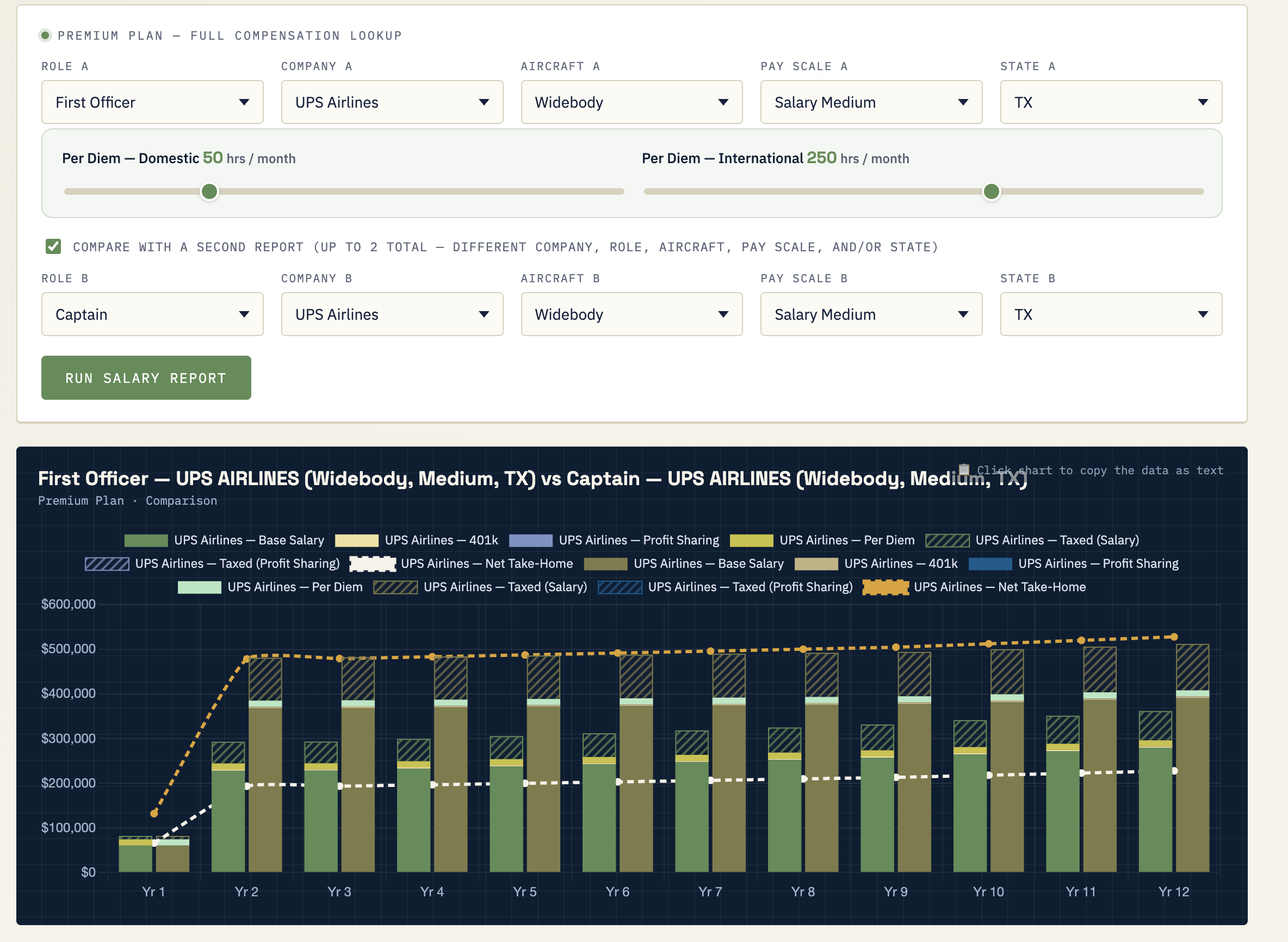
Let's look at the actual data. When you hire on at UPS, your first year serves as a training year. A Year 1 Widebody First Officer takes home just $52,040 after paying $7,730 in federal taxes. You earn a negligible $598 in 401k contributions during this probationary period.
But watch what happens the moment you cross into Year 2. A Year 2 Widebody First Officer sees their net base salary explode to $179,341 (after $48,699 in federal taxes). If you hold a Captain seat in Year 2, your net take-home pay skyrockets to $271,320 (after paying $96,070 in taxes).
By the time you reach Year 12 as a Widebody Captain, you net a staggering $286,233 in pure base salary after absorbing $103,977 in federal taxes. On top of that, you pull in $11,490 in untaxed per diem. Yet, your company 401k contribution sits at a meager $3,902.
The IPA designed this deliberately. They force UPS to pay you massive hourly rates. You don't wait until age 65 to access your wealth. You receive liquid capital during your active flying years. You can see exactly how this heavy base-pay strategy stacks up against the massive 401k deposits of passenger airlines in our Delta Air Lines vs UPS Airlines Pilot Pay and United Airlines vs UPS Airlines Pilot Pay comparisons.
The Real Retirement Package
If you look purely at that $3,902 company contribution, UPS looks like the worst retirement destination in aviation. That assumption ignores the massive defined benefit plan operating quietly in the background.
UPS pilots still have a pension.
When the passenger carriers (like United, Delta, and American) navigated severe bankruptcies in the early 2000s, they terminated their pilot pensions. To make up for stripping away that guaranteed retirement income, the ALPA contracts at those passenger carriers demanded massive 16% to 17% direct 401k contributions. They replaced the pension with heavy upfront cash deposits into pilot-managed retirement accounts.
Cargo carriers never faced those bankruptcies. UPS and FedEx kept their defined benefit plans. Because UPS funds a massive, guaranteed pension payout for you at age 65, they don't fund a massive 401k. The $3,902 contribution you see at Year 12 acts merely as a supplemental drop in the bucket.
You receive a guaranteed monthly check for the rest of your life. The company absorbs the stock market risk. If the market crashes the year you retire, your UPS pension remains completely intact. You trade the massive 401k deposits of the passenger world for the impenetrable safety net of a legacy pension. Read our full analysis on cargo pensions in our FedEx Pilot Pay 2026 Guide and see the direct cargo-to-cargo math in our FedEx Express vs UPS Airlines Pilot Pay breakdown.
If you prefer the passenger model where the company hands you $60,000+ a year to invest yourself, you should explore the American Airlines vs UPS Airlines Pilot Pay metrics.
What UPS Pilots Actually Do
How do actual UPS pilots build wealth with such a small company 401k match? They leverage their massive base salaries and become their own wealth managers.
A Year 8 Widebody First Officer clears $195,779 in net take-home pay and $11,490 in untaxed per diem. A Year 8 Widebody Captain nets $276,640. When you pull down that much liquid cash every single year, you don't wait for the company to fund your retirement. You fund it yourself.
Smart UPS pilots max out their personal IRS 401k contribution limits every single year. They funnel their extra cash into Roth IRAs, backdoor Roths, and heavy real estate investments. Because the IPA contract hands them extreme liquid capital up front, they dictate exactly how, when, and where their money grows.
If you currently fly for a regional airline, this level of cash flow completely changes your financial reality. You stop surviving paycheck to paycheck and start acting like an institutional investor. See how fast this wealth builds by modeling a career jump in our Envoy Air vs UPS Airlines Pilot Pay or SkyWest Airlines vs UPS Airlines Pilot Pay tools.
When This Structure Works
This unique contract structure caters to a very specific type of aviator. It works perfectly for pilots who demand complete control over their liquid capital today, while securing a bulletproof pension floor for tomorrow.
If you hate the idea of your company locking 17% of your compensation inside a restricted 401k account for three decades, UPS offers the perfect alternative. You take the cash now. You buy the investment properties. You fund your children's college accounts immediately.
If you fly for a narrowbody-exclusive carrier and want to transition to heavy widebody wealth, UPS offers an immediate upgrade in raw cash flow. Compare the differences in our Alaska Airlines vs UPS Airlines Pilot Pay, Southwest Airlines vs UPS Airlines Pilot Pay, and JetBlue Airways vs UPS Airlines Pilot Pay analyses.
You trade the passenger profit-sharing checks for guaranteed, massive hourly rates. You trade the massive 401k deposits for a defined benefit pension.
FAQ Section
Does UPS have a pension for its pilots?
Yes. UPS utilizes a defined benefit pension plan that guarantees a specific monthly payout when you retire. This acts as the primary wealth vehicle, which directly explains why their company 401k contributions remain so low compared to ALPA passenger carriers.
Should I contribute personally to my UPS 401k?
Yes. Because the company only contributes nominal amounts (scaling from $598 in Year 1 to $3,902 in Year 12 for captains), you must fund your own 401k using your massive base salary to gain tax-advantaged market exposure.
Is the UPS retirement package really worse than Delta or United?
No, it operates differently. Delta and United rely entirely on massive direct 401k contributions because they don't offer pensions. UPS offers a pension that guarantees your income for life. One relies on stock market performance; the other relies on a guaranteed formula.
How do I maximize my UPS benefits?
You maximize the UPS contract by surviving the low-paying Year 1 training period, bidding for highly efficient widebody international routes to maximize your per diem, and aggressively investing your massive net base salary into your own personal retirement accounts.
The Bottom Line
The UPS pilot 401k structure frustrates outsiders who don't understand the math. If you only look at the $3,902 company contribution for a senior captain, you miss the entire financial picture.
The Independent Pilots Association explicitly chose to funnel the company's wealth directly into your paycheck and your pension. They secured a Year 12 Widebody Captain a net base salary of $286,233. They secured a massive guaranteed payout at age 65.
UPS pilots don't need the company to manage their 401k. They take their cash, they invest it on their own terms, and they fly heavy freight with absolute financial security. Don't let a misunderstood retirement column push you away from one of the most lucrative careers in global aviation. Compare your exact options and map your future using the definitive tools at skylevels.fyi.