American Airlines vs United Airlines Pilot Pay Comparison
United widebody captains earn $48,763 more than American widebody captains at Year 12. But American offers specific base city advantages that some pilots prefer. Here's the complete comparison beyond just the pay numbers.
You face a career-defining choice when multiple legacy carriers offer you a class date. American Airlines and United Airlines both represent the absolute pinnacle of commercial aviation, offering massive widebody fleets and lifetime earnings pushing $10 million. But their union contracts distribute that wealth differently. You can't just look at the hourly rate and assume parity.
While the recent contract cycles brought hourly base rates into alignment across the Big Three, the total W-2 compensation still varies. United pulls ahead in pure cash flow and 401k deposits. American counters with an incredibly dominant Sunbelt route network and fiercely independent union protections.
We pulled the exact, tax-adjusted data from the skylevels.fyi database to expose the real numbers. We modeled the data for a Texas resident to eliminate state income tax noise and show you exactly what hits your checking account. Here is the true financial comparison between American Airlines and United Airlines.
Base Pay Head-to-Head
Your base salary forms the bedrock of your aviation wealth. Both carriers operate under new contracts that dramatically increased pilot compensation, but United maintains a clear advantage in actual net take-home pay at every single career milestone.
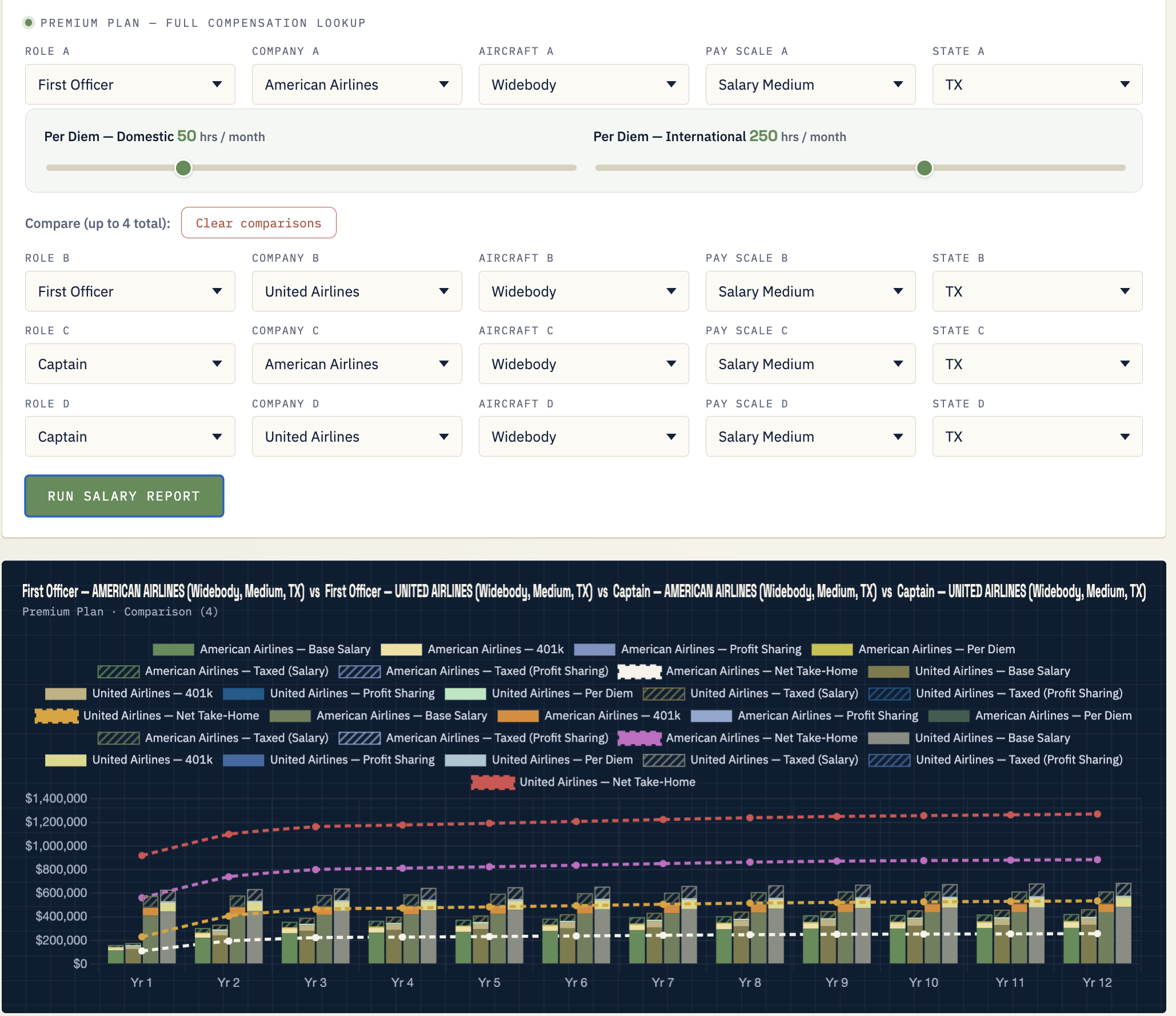
Let's look at the First Officer progression. A Year 1 Widebody First Officer at United nets $107,888 in base salary. The equivalent First Officer at American nets $99,892. United hands you an $8,000 advantage in your very first year on the property. By Year 5, a United Widebody First Officer clears $239,303 in pure net cash. The American First Officer takes home $222,196.
The gap widens when you upgrade to the left seat. A Year 1 Widebody Captain at United nets $346,142. A Year 1 Widebody Captain at American takes home $320,952.
At the absolute peak of the pay scale, United solidifies its dominance. A Year 12 Widebody Captain at United clears $374,444 in net base salary. The American Captain clears $339,887.
Net Base Salary Comparison (Texas Resident)
| Career Stage | United Net Base Salary | American Net Base Salary | Difference |
|---|---|---|---|
| Year 1 Widebody FO | $107,888 | $99,892 | United +$7,996 |
| Year 5 Widebody FO | $239,303 | $222,196 | United +$17,107 |
| Year 1 Widebody Capt | $346,142 | $320,952 | United +$25,190 |
| Year 12 Widebody Capt | $374,444 | $339,887 | United +$34,557 |
United wins the base pay battle decisively. If you want to see exactly how these legacy rates crush the low-cost carrier market, run the numbers in our American Airlines vs Southwest Airlines Pilot Pay and American Airlines vs JetBlue Airways Pilot Pay comparison tools.
401k and Benefits Comparison
You build true generational wealth through your 401k. Legacy carriers utilize a defined contribution model, depositing massive amounts of cash directly into your retirement account without requiring you to match a single dollar.
United Airlines operates the most aggressive 401k engine in the passenger sector. They drop 17% of a pilot's eligible earnings directly into their retirement portfolio. American Airlines provides highly lucrative contributions, but they fall slightly short of the United benchmark.
Look at the Year 12 Widebody Captain data. United drops a staggering $82,236 into that captain's 401k in a single year. American contributes $69,950. That $12,286 annual difference compounds massively over a twenty-year career. You lose hundreds of thousands of dollars in investment capital if you choose American over United.
Per diem also tilts slightly toward United. A standard United schedule generates roughly $12,090 in untaxed per diem annually. American pilots generate roughly $9,780. Because per diem flows to you completely untaxed, this $2,310 difference acts as a pure cash advantage for the United pilot.
If you want to see how these massive 401k deposits stack up against the legacy defined benefit pensions of the cargo world, review the math in our American Airlines vs FedEx Express Pilot Pay and American Airlines vs UPS Airlines Pilot Pay breakdowns.
Base City Analysis
You ruin a massive paycheck if you commute. Your airline choice must revolve around your home address. Base pay advantages vanish the moment you start paying for crash pads and sitting in jumpseats on your days off.
American Airlines commands immense geographical dominance across the Sunbelt and the East Coast. They operate the ultimate superhub in Dallas/Fort Worth (DFW). They control massive narrowbody flow through Charlotte (CLT) and dominate Latin American flying out of Miami (MIA). They maintain critical Northeast access through Philadelphia (PHL) and New York (JFK/LGA).
United Airlines anchors its global network in completely different markets. They dominate the West Coast with a massive operation in San Francisco (SFO). They run heavy international routes out of Newark (EWR) and Washington Dulles (IAD). They control the Midwest through Chicago (ORD) and operate huge hubs in Houston (IAH) and Denver (DEN).
If you live in Dallas or Charlotte, American Airlines hands you a lifestyle advantage that easily offsets the $48,763 pay gap. You drive to work. You sleep in your own bed. If you live in Denver or San Francisco, United offers the exact same geographical sanctuary.
Don't commute to chase a slightly higher 401k contribution. Pick the airline that places a base in your city. Compare your exact regional transition options using our American Airlines vs Envoy Air Pilot Pay and American Airlines vs SkyWest Airlines Pilot Pay tools to map out your specific relocation strategy.
Career Progression
You fly heavy metal at both airlines. Both carriers operate massive widebody fleets that allow you to escape narrowbody pay scales relatively early in your career.
United holds a distinct advantage in sheer fleet growth. They placed the largest widebody order in commercial aviation history, aggressively expanding their Boeing 787 Dreamliner fleet. A larger widebody fleet mathematically increases your chances of securing a high-paying widebody Captain or First Officer position earlier in your progression.
American Airlines operates a highly stable, modernized fleet of Boeing 777s and 787s. They focus heavily on maintaining their lucrative domestic and near-international network while running targeted long-haul operations.
Your union representation also differs. United pilots fly under ALPA. American pilots fly under the Allied Pilots Association (APA). The APA operates as a fiercely independent union, negotiating specific work rules and trip-trading mechanics that many American pilots weaponize to maximize their days off.
You control your destiny at either carrier. You can bid for a junior base to upgrade quickly, or you can sit comfortably in the right seat in your home city and pull down $240,000+ as a senior First Officer. See how the other major legacy carrier fits into this puzzle by reading our American Airlines vs Delta Air Lines Pilot Pay analysis.
Which Fits Your Life
The numbers heavily favor United Airlines. A Year 12 Widebody Captain at United generates a massive $466,700 total compensation package (combining net base, 401k, and per diem). The equivalent American Airlines Captain generates $417,937.
You leave nearly $50,000 on the table every single year you fly for American instead of United.
But you don't fly a spreadsheet. You fly an airplane. If United forces you to commute from Miami to Newark every week, the extra $50,000 won't save your marriage or your physical health. American offers an elite, highly compensated career that still places you in the top 1% of American earners.
Choose United if you want the absolute highest guaranteed retirement deposits and massive widebody route expansion. Choose American if you live near an American hub and value the fierce independence of the APA contract.
FAQ Section
Which airline pays more overall? United Airlines pays significantly more across almost all career stages. Their higher credited base hours and industry-leading 17% 401k contributions create a total compensation gap of roughly $48,763 at the senior widebody captain level.
Should I choose American if I live in Dallas? Yes. Living in base acts as the ultimate quality of life multiplier. DFW is American's crown jewel. You avoid the stress of commuting and gain access to an incredible variety of routes and schedules.
How do these two compare to Delta? Delta Air Lines matches the base rates but relies heavily on variable profit-sharing checks to boost their W-2s. Read our full Delta Pilot Pay Guide for the complete breakdown. You can also explore the specific United mechanics in our United Pilot Pay Guide and the American specifics in our American Pilot Pay Guide.
Is upgrading to widebody faster at United? Currently, yes. United's massive widebody aircraft orders create more left-seat and right-seat heavy metal opportunities, allowing pilots to access the highest pay bands faster than at carriers with stagnant widebody growth.
Make your decision using raw data. Compare your exact age, seniority expectations, and equipment goals side-by-side using the American Airlines vs United Airlines Pilot Pay tool at skylevels.fyi.