Best Regional Airlines and LCCs for Pilots in 2026
Alaska Airlines captains earn $315,570 at year 11 flying regular narrowbodies. JetBlue captains earn $344,264 at year 12 with profit sharing. SkyWest captains earn $172,031 at year 12. The gap between regional and major LCC compensation is now $172,000 annually. Choosing correctly matters more than pilots realize.
You cannot afford to treat your career progression like a random lottery. You need a deliberate strategy. The aviation landscape split aggressively in 2026. Low-cost carriers (LCCs) and national airlines distanced themselves from the regional feeders, establishing compensation packages that rival the legacy giants. Pilots grinding away in the right seat of a regional jet often misunderstand exactly how much money they leave on the table every single year.
We pulled the hard data from the skylevels.fyi database to expose the real numbers. This analysis strips away the recruiting propaganda and looks purely at total W-2 compensation. We compare the premier regional carrier, SkyWest Airlines, against three heavy-hitting LCC and national carriers: Alaska Airlines, JetBlue Airways, and Sun Country Airlines.
Your first airline job dictates the trajectory of your entire financial life. Picking the wrong regional or delaying your transition to a major LCC costs you millions in lost retirement contributions and base pay. You must understand the exact math before you sign a conditional job offer. Let's break down the actual earning power of these airlines so you can navigate your career with absolute precision.
The Current Landscape 2026
The 2026 hiring environment operates differently than the desperate post-pandemic frenzy. Airlines stabilized their training departments. They stopped handing out blank checks to anyone with 1,500 hours. Carriers now demand quality, experience, and strategic career planning.
This stabilization created a distinct multi-tiered market. Legacy carriers sit at the top. LCCs and national carriers like Alaska and JetBlue occupy a massively lucrative middle tier. Regional airlines like SkyWest and Envoy sit at the bottom, operating strictly as stepping stones. The financial gap between these tiers exploded following the 2023-2024 contract cycles.
Regional airlines threw massive sign-on bonuses at pilots for a few years to stop the bleeding. That era ended. The regional airlines reverted to their structural reality: they operate on razor-thin margins dictated by their legacy partners. They cannot match the long-term wealth generation of an airline that sells its own tickets.
Meanwhile, carriers like Alaska Airlines and JetBlue leveraged their distinct market shares to fund massive ALPA contract improvements. They secured hourly rates that mirror Delta and United. They locked in double-digit 401k contributions. They transformed from stepping-stone airlines into destination careers.
You face a critical decision. Do you stay at a regional airline to upgrade quickly, or do you jump to an LCC First Officer seat the moment you meet the minimum qualifications? The math provides a brutal answer. Every year you stay at a regional carrier, you forfeit over $100,000 in lost compensation and retirement matching.
Market shifts favor the aggressive pilot. Read our Regional vs Major Airline Career Decision guide. You must map out your escape from the regional tier immediately. The data below proves exactly why lingering at a regional airline destroys your lifetime wealth.
SkyWest Deep Dive
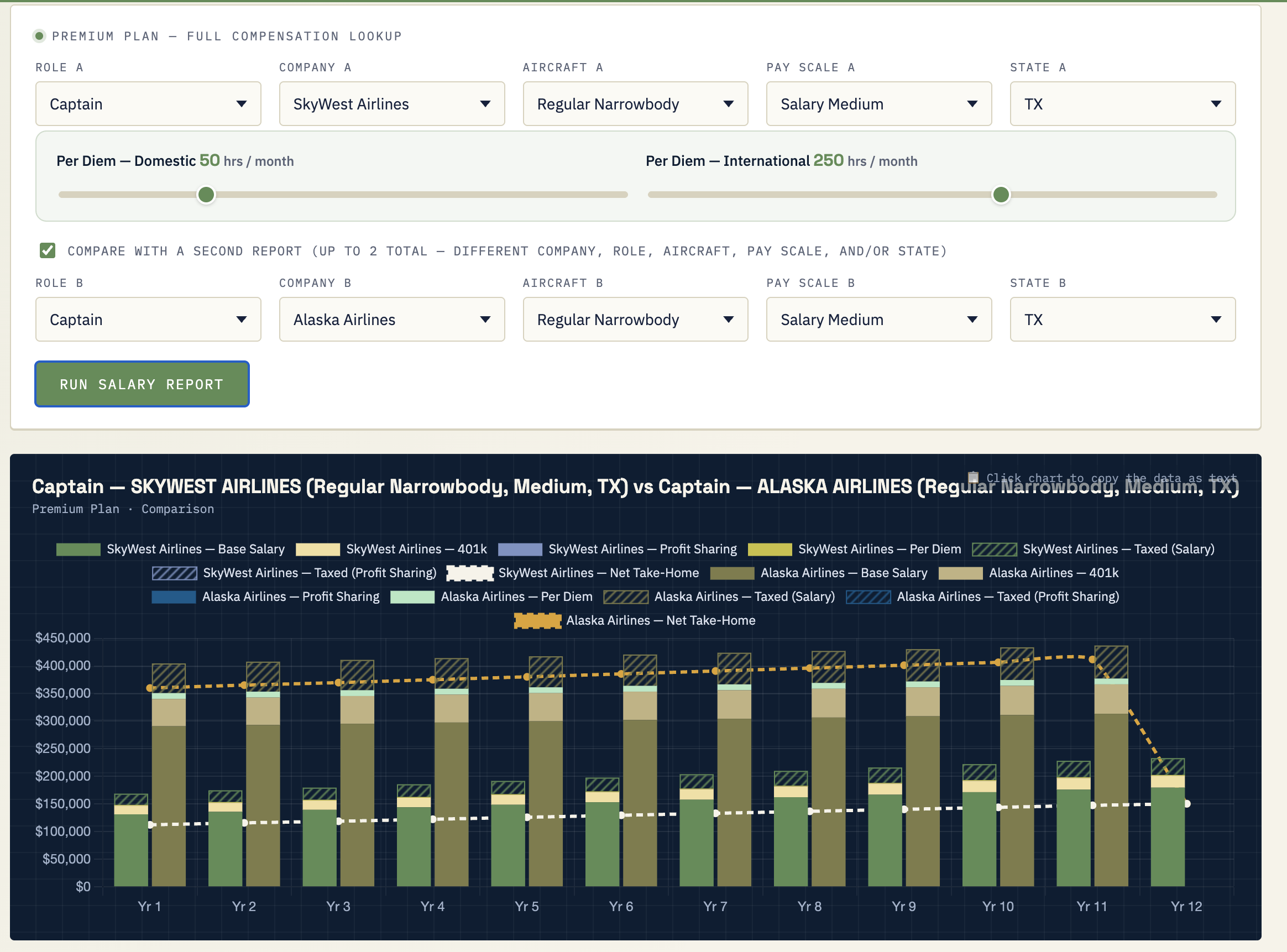
SkyWest Airlines stands as the undisputed titan of the regional sector. They operate massive fleets for Delta, United, American, and Alaska. They run a highly efficient, professional operation. But their pay scale reflects their status as a regional capacity provider, not a mainline carrier.
Let's look at the exact total compensation for a SkyWest pilot over a 12-year timeline.
- Year 1: $128,103 total
- Year 5: $143,851 total
- Year 8: $156,283 total
- Year 12: $172,031 total ($149,121 base + $21,560 401k + $1,350 per diem)
These numbers provide a comfortable living. A Year 12 Captain making $172,031 out-earns the vast majority of American workers. However, in the aviation context, this compensation package falls woefully short.
SkyWest offers an incredible training footprint and massive base options across the country. You can live in Boise, Salt Lake City, Fresno, or Colorado Springs and drive to work. For some pilots, that lifestyle flexibility trumps maximum compensation.
But you pay a massive premium for that convenience. SkyWest caps your earning potential strictly because they only fly regional jets. You will never see a widebody pay scale. You will never see a massive mainline profit-sharing check. You hit a financial brick wall.
SkyWest operates excellent pathway programs. They funnel pilots directly into United Airlines and Delta Air Lines. You should absolutely use these programs. Treat SkyWest as an elite training ground. Grab your 1,000 hours of Part 121 turbine time, get your Captain upgrade, and get out. You can compare the exact cost of staying too long using our Alaska Airlines vs SkyWest Airlines Pilot Pay tool.
Alaska Airlines Deep Dive
Alaska Airlines blurs the line between a low-cost carrier and a legacy giant. They dominate the Pacific Northwest. They swallowed Hawaiian Airlines. Their ALPA contract reflects their status as a major national powerhouse.
Look at the staggering difference in total compensation when you step up to Alaska:
- Year 1: $295,304 total
- Year 5: $302,821 total
- Year 8: $309,570 total
- Year 11: $315,570 total ($253,567 base + $53,273 401k + $8,730 per diem)
Alaska completely eclipses the regional market. A Year 11 Captain at Alaska pulls down $315,570. That beats the Year 12 SkyWest Captain by over $143,000 annually.
Alaska Airlines offers an incredible West Coast lifestyle. If you live in Seattle, Portland, Anchorage, or Los Angeles, Alaska provides a phenomenal destination career. You avoid the toxic commute. You fly modern Boeing 737s across a massive domestic and near-international network.
The recent contract negotiations secured incredible 401k contributions and base rates that rival the Big Three. You do not sacrifice your financial future by flying for the Eskimo. You secure it. Compare Alaska directly against the legacies in our Alaska Airlines vs Delta Air Lines Pilot Pay and Alaska Airlines vs United Airlines Pilot Pay breakdowns.
If you want to see how Alaska stacks up against American, check out Alaska Airlines vs American Airlines Pilot Pay. They offer top-tier compensation without the massive, impersonal corporate bureaucracy of a legacy carrier.
JetBlue Airways Deep Dive
JetBlue Airways built its brand on East Coast dominance and a premium passenger experience. Despite recent corporate turbulence and blocked mergers, their pilot compensation remains absolutely top-tier. JetBlue pilots operate under a powerful ALPA contract that delivers heavy W-2 firepower.
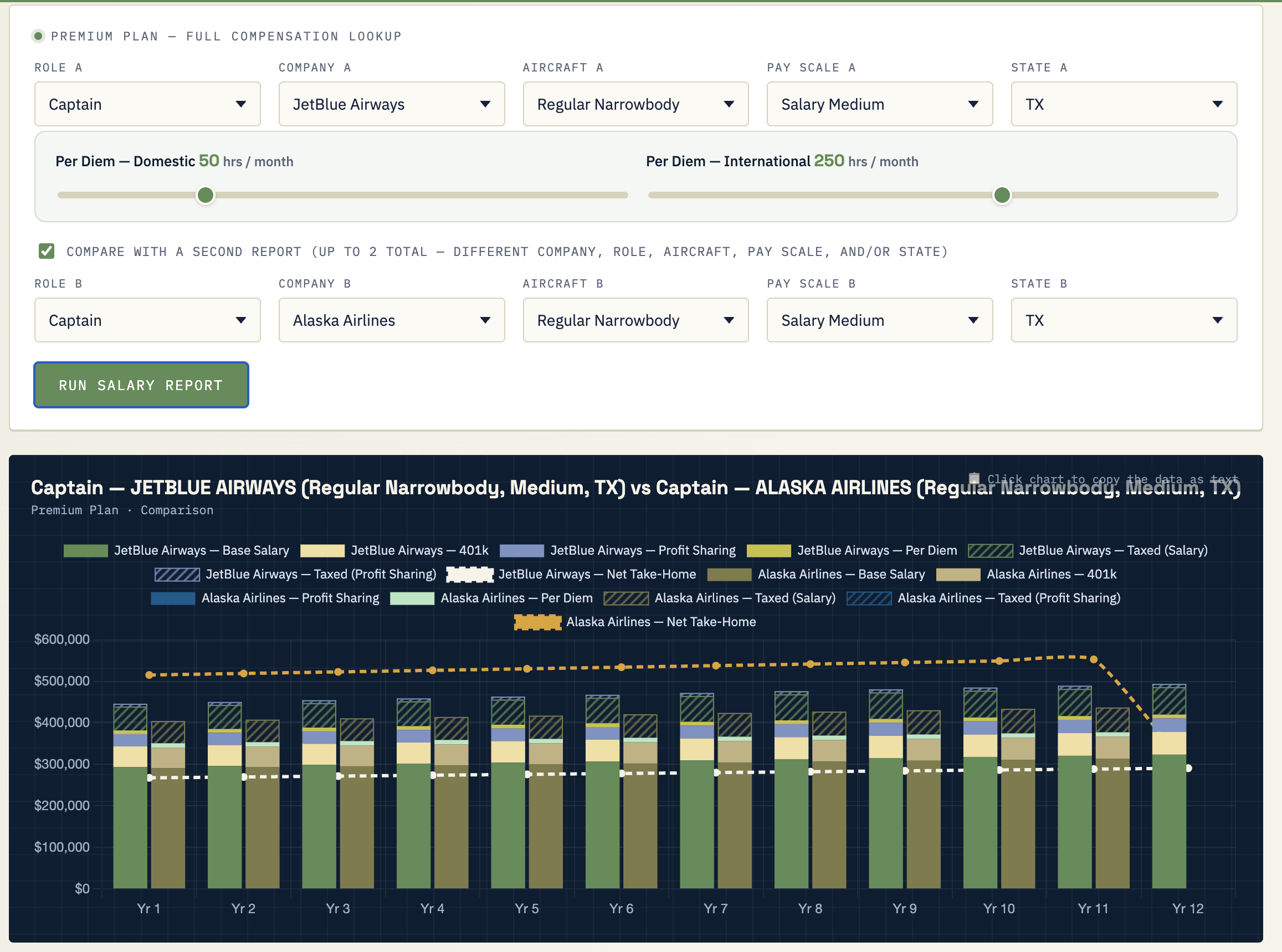
Here is the exact progression for JetBlue, factoring in their unique profit-sharing structure:
- Year 1: $315,953 total
- Year 5: $326,125 total
- Year 8: $333,889 total
- Year 12: $344,264 total ($257,364 base + $54,987 401k + $24,383 profit sharing + $7,530 per diem)
JetBlue obliterates the regional airlines. A Year 12 Captain taking home $344,264 sits firmly in legacy carrier territory. The critical differentiator for JetBlue is their profit-sharing mechanism. They distribute $24,383 to a Year 12 Captain in a standard year. SkyWest offers zero comparable profit sharing.
JetBlue operates a massive fleet of Airbus A320 and A220 aircraft. They fly transcontinental heavy routes and push deep into the Caribbean and South America. If you live in New York, Boston, or Fort Lauderdale, JetBlue offers an incredible quality of life.
You must weigh the corporate stability. JetBlue faces intense market pressure from the legacy carriers. But their contract protects the pilots. Even if the company struggles, the hourly rates and 401k match remain contractually obligated.
See exactly how JetBlue beats the regional feeders in our Alaska Airlines vs JetBlue Airways Pilot Pay analysis. They provide a massive, immediate financial upgrade for any regional pilot willing to make the jump.
Sun Country Airlines Deep Dive
Sun Country Airlines operates as a fascinating hybrid. They fly scheduled passenger service, massive military charter operations, and dedicated cargo flights for Amazon. This diversification protects them from standard industry shocks.
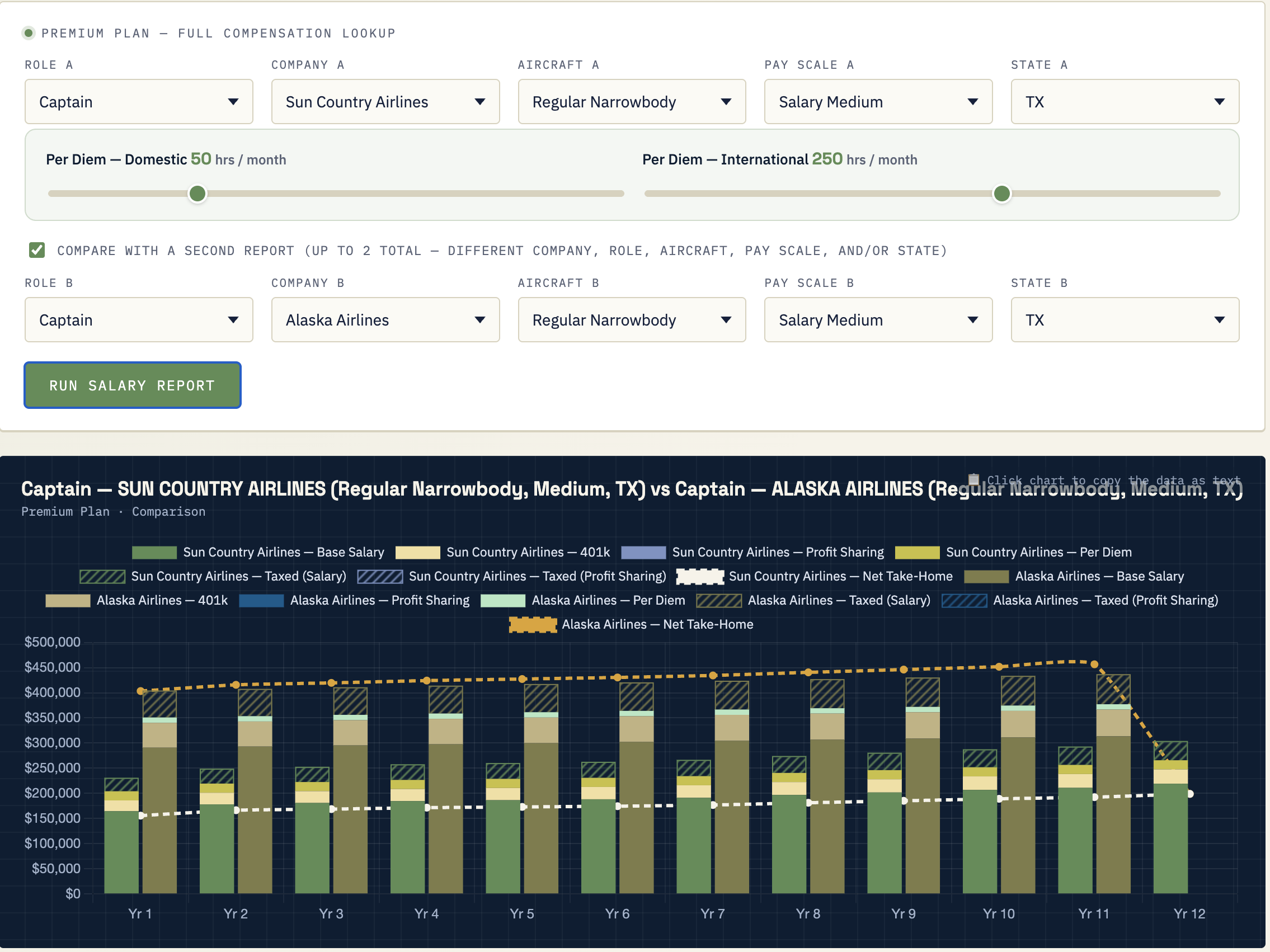
Their pay scale reflects their status as a growing, ultra-low-cost carrier (ULCC):
- Year 1: $173,833 total
- Year 5: $193,960 total
- Year 8: $203,594 total
- Year 12: $224,996 total ($180,805 base + $28,491 401k + $14,850 per diem)
Sun Country sits perfectly between the regional feeders and the major LCCs. A Year 12 Captain at Sun Country earns $224,996. That beats SkyWest by over $52,000 a year. It falls short of Alaska and JetBlue, but it offers a wildly different lifestyle.
Sun Country anchors its operation in Minneapolis (MSP). If you live in the Midwest, this airline offers incredible flexibility. You fly a mix of Caribbean vacationers and nighttime Amazon freight. You get variety.
They offer an excellent stepping stone or a comfortable destination career for pilots who prioritize base location over maximum W-2 cash. They hire aggressively, upgrade pilots quickly, and offer a much faster path to the left seat than JetBlue or Alaska.
The Comparison Framework
You need to see the data side-by-side. We isolated the top end of the pay scales to show you exactly what your ultimate earning potential looks like at each carrier.
| Airline | Year 12 Total | Type | Key Advantage |
|---|---|---|---|
| JetBlue | $344,264 | LCC Major | Profit sharing |
| Alaska (Yr 11) | $315,570 | LCC Major | West coast base |
| Sun Country | $224,996 | LCC | Growing carrier |
| SkyWest | $172,031 | Regional | Pathway programs |
The gap between an LCC Major and a Regional airline is staggering. You lose $172,233 every single year you stay at SkyWest instead of flying for JetBlue. Over ten years, that gap exceeds $1.7 million.
You cannot afford to get comfortable at a regional airline. The financial penalty destroys your retirement. You use regional airlines to build time. You use LCCs and legacy carriers to build wealth.
If you live on the West Coast, target Alaska. See how they stack up against Southwest in our Alaska Airlines vs Southwest Airlines Pilot Pay guide. If you want cargo stability, check out Alaska Airlines vs FedEx Express Pilot Pay and Alaska Airlines vs UPS Airlines Pilot Pay. If you fly for Envoy, run the exact math on your escape plan with our Alaska Airlines vs Envoy Air Pilot Pay tool.
Match your airline choice to your home address. Do not commute. Pick the highest-paying carrier with a base in your city.
FAQ
Which regional pays best? SkyWest and Envoy lead the regional pack in overall quality of life and compensation stability. However, even the best regional airline pays roughly $150,000 less per year than a major LCC. You do not stay at a regional for the pay. You stay for the upgrade time.
Is Alaska Airlines considered major? Yes. Alaska Airlines operates as a major national carrier. Their ALPA contract, 401k structure, and hourly rates firmly place them in the top tier of aviation compensation. They compete directly with Delta, United, and American for top-tier talent.
Should I start at JetBlue? If JetBlue offers you a class date, you take it. JetBlue offers an incredible Year 1 package and industry-leading profit sharing for an LCC. Do not pass up an LCC class date to chase a legacy carrier unless you have a hard offer in hand.
What about Sun Country growth? Sun Country offers an incredible opportunity for fast upgrades. Because they operate a unique mix of passenger and cargo flights, they insulate their pilots from economic downturns better than pure passenger ULCCs. If you live in Minneapolis, Sun Country is a highly lucrative choice.
Conclusion
Stop listening to crew room gossip. The data tells the entire story. Alaska Airlines and JetBlue transformed themselves into massive wealth-generating machines for their pilots. Regional airlines like SkyWest remain essential training environments, but they severely cap your financial future.
You must build a deliberate career framework. Get your hours at a regional airline. Secure your turbine time. Then, aggressively target an LCC or legacy carrier. Do not accept the $172,000 annual pay cut that comes with staying in the regional tier.
Every month you delay your transition costs you thousands of dollars in unrecoverable 401k contributions. Use our comprehensive guides to map your exact path. Read the Complete Guide to Delta Air Lines Pilot Pay in 2026, check the Delta First Year Pilot Pay numbers, and explore our full Career Bundle.
Run your specific age, equipment goals, and seniority projections through the interactive skylevels.fyi tool today. Secure your wealth.