Hawaiian Airlines First Officer Pay Progression Explained
Hawaiian Airlines first officers see the biggest pay jump in the industry between Year 1 and Year 2. Year 1: $69,584 total. Year 2: $147,323 total. That's a 111% increase - and it changes how pilots should think about the first year sacrifice.
You stare at the conditional job offer from Hawaiian Airlines and feel your stomach drop. You look at the Year 1 pay scale and wonder how you'll survive in one of the most expensive states in the country. You likely made more money as a senior captain at your regional airline. The financial step backward terrifies you.
Don't panic. You must look past the first twelve months.
Hawaiian Airlines operates a brutally restrictive probationary pay scale that suppresses your initial earnings. But the moment you cross your one-year anniversary, your wealth engine ignites. We pulled the exact, tax-adjusted data from the skylevels.fyi database to map out this specific progression. We modeled the numbers for a pilot residing in a tax-free state like Texas to isolate the pure federal take-home pay.
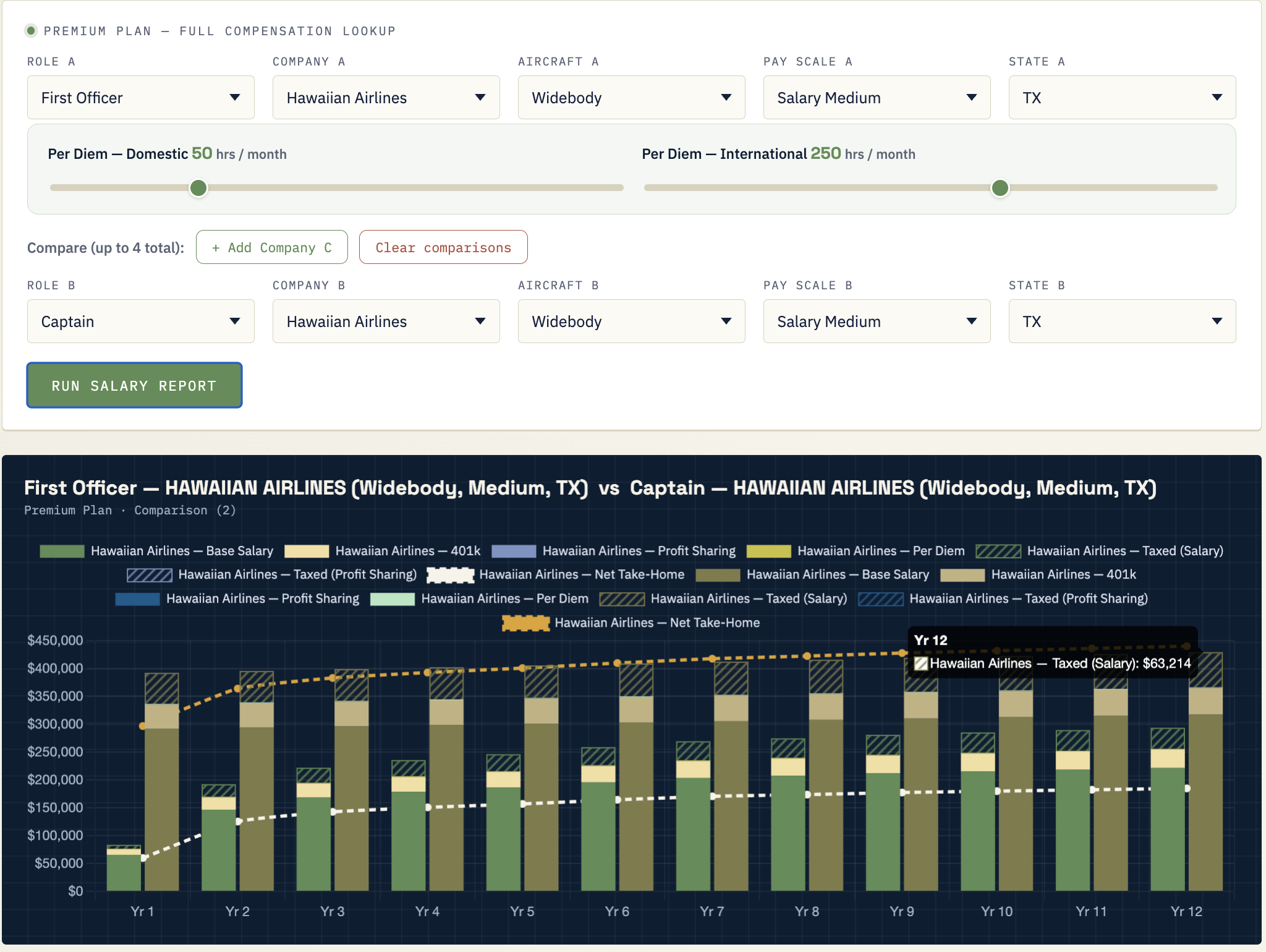
You need to understand the mechanics of this massive 111% raise. We broke down the exact progression from your low-earning training months to your peak earning years as a senior widebody first officer. Here's the true financial trajectory at Hawaiian Airlines.
The Year 1 to Year 2 Jump Explained
The financial friction you experience during your first year at Hawaiian Airlines acts as an industry-standard initiation. The airline pays you a flat training rate while you spend months in the simulator learning to fly heavy metal.
Let's look at the exact dollars. A Year 1 First Officer takes home a net base salary of $58,556 after paying roughly $6,964 in federal taxes. The company deposits $9,828 into your 401k. You generate roughly $1,200 in per diem. Your total compensation package equals $69,584.
If you live in Honolulu, $69,584 barely covers your rent and groceries. You bleed cash.
Then your one-year anniversary hits. Your probationary status ends. You transition to the Year 2 pay scale, and your financial reality completely transforms.
A Year 2 First Officer sees their net base salary explode to $124,127. Your company 401k contribution skyrockets to $21,996. You generate the same $1,200 in per diem. Your total compensation package instantly scales to $147,323.
You gain a massive $77,739 raise overnight. This 111% increase represents the steepest single-year pay jump in commercial aviation. You transition from a survival budget to an aggressive wealth-building strategy. If you want to see how this compares to other legacy training years, study our Delta First Year Pilot Pay breakdown. Delta smooths their progression out slightly better, but the Hawaiian Year 2 correction aggressively fixes the initial financial penalty.
Full FO Progression Year-by-Year
Your pay doesn't stagnate after Year 2. The Air Line Pilots Association (ALPA) contract dictates a steady, lucrative climb as you build seniority.
Hawaiian Airlines operates a highly unified pay structure for its right-seat aviators. Based on the 2026 contractual data, the pay rates for Midsize and Widebody First Officers mirror each other perfectly. You earn the exact same W-2 whether you fly the inter-island routes or cross the Pacific.
Here's your exact total compensation trajectory, factoring in net base pay, 401k deposits, and per diem:
| Career Stage | Net Base Salary | 401k Contribution | Per Diem | Total Compensation |
|---|---|---|---|---|
| Year 1 | $58,556 | $9,828 | $1,200 | $69,584 |
| Year 2 | $124,127 | $21,996 | $1,200 | $147,323 |
| Year 3 | $141,512 | $25,272 | $1,200 | $167,984 |
| Year 4 | $149,584 | $26,793 | $1,200 | $177,577 |
| Year 5 | $155,792 | $27,963 | $1,200 | $184,955 |
| Year 8 | $172,556 | $31,122 | $1,200 | $204,878 |
| Year 12 | $183,732 | $33,228 | $1,200 | $218,160 |
You break the $200,000 total compensation threshold by Year 8. At Year 12, you top out the First Officer scale at $218,160. You take home $183,732 in liquid cash after the IRS takes its $37,788 cut. You secure a $33,228 direct deposit into your retirement account.
You build massive wealth without ever taking the command responsibilities of the left seat. You hold maximum schedule flexibility, dictate your days off, and enjoy an elite quality of life. If you want to see how these senior right-seat numbers match up against full legacy captains, cross-reference this data using our American Airlines vs Delta Air Lines Pilot Pay and American Airlines vs United Airlines Pilot Pay comparison tools.
Why This Structure Exists
Airlines weaponize probationary pay to protect their training investments.
Training a new pilot to fly an Airbus A330 or a Boeing 787 Dreamliner costs the airline tens of thousands of dollars. They pull you off the revenue line for months to run you through the simulator. During this period, you generate zero revenue for the company.
Hawaiian Airlines suppresses your Year 1 pay to offset this massive institutional cost. They know you won't quit during your first year because leaving requires you to start over at the bottom of another airline's seniority list. The union accepts this suppressed first-year rate in exchange for driving massive capital into the senior pay bands. They sacrifice the new hires to protect the veteran pilots.
You pay your dues. The airline secures its training investment. Then, the handcuffs come off in Year 2, and they compensate you as a fully qualified heavy metal aviator.
Financial Planning for First Year
You must prepare for the Year 1 cash crunch. You can't walk into a Hawaiian Airlines class date with massive high-interest credit card debt and zero savings.
Aggressively stockpile your regional airline sign-on bonuses before you make the jump. If you currently fly for Envoy or SkyWest, map out your transition using our American Airlines vs Envoy Air Pilot Pay and American Airlines vs SkyWest Airlines Pilot Pay tools to pinpoint exactly when you can afford the temporary pay cut.
Live lean. Don't buy a house in Honolulu during your probationary year. Rent a cheap crash pad or apartment, fly your schedule, and survive the twelve-month hazing period. The moment you hit Year 2, you unlock the capital required to build a permanent life in the islands.
FAQ Section
Why is the Hawaiian per diem so low?
Our data shows $1,200 in annual per diem. This reflects a pilot flying heavily on the inter-island network. When you fly between Honolulu and Maui, you often start and finish your day at your home base. You don't sleep in hotels, so you don't generate massive overnight per diem hours. This keeps your untaxed per diem yield around $1,200 annually.
Does the Alaska merger change this progression?
The merger creates massive long-term opportunities for route expansion, but your current pay relies on the negotiated contracts. As the seniority lists integrate, your bidding power will shift, but the mathematical reality of surviving Year 1 remains intact.
Is surviving Year 1 worth it?
Yes. You trade twelve months of strict budgeting for a lifetime of elite wealth. Run your full career numbers at skylevels.fyi and review our Hawaiian Airlines Pilot Pay in 2026 Guide to see the $300,000+ captain paychecks waiting for you on the other side.