Complete Guide to Hawaiian Airlines Pilot Pay in 2026
Hawaiian Airlines midsize captains earn $303,065 total compensation at Year 12. That's competitive with Alaska Airlines and higher than Sun Country. The Alaska-Hawaiian merger creates unique career opportunities most pilots haven't calculated yet.
You face a radically different aviation landscape in 2026. The major carriers solidified their contracts, and the heavy consolidation phase reached its peak. When Alaska Airlines moved to acquire Hawaiian, it altered the career trajectories of thousands of aviators. You can't analyze a job offer from Hawaiian Airlines by looking at the old legacy models. You must look at what this airline represents right now.
Hawaiian offers a unique lifestyle, flying heavy metal across the Pacific and operating rapid inter-island hops. They fly under an Air Line Pilots Association (ALPA) contract that delivers heavy W-2 firepower, but their pay structure features distinct anomalies you won't find at a mainland legacy carrier.
We pulled the exact, tax-adjusted data from the skylevels.fyi database to expose the real numbers. We modeled the data for a pilot residing in a tax-free state like Texas to eliminate state income tax noise and show you exactly what hits your checking account. This removes the massive Hawaii state tax burden from the equation, giving you a pure baseline. Here's the true financial reality of flying for Hawaiian Airlines.
Map Your Trajectory: Don't guess with your financial future. Model your exact career timeline using the skylevels.fyi comparison tools to see how your specific scenario stacks up against the rest of the industry.
Hawaiian Pay Structure
Hawaiian Airlines compensates its pilots through a traditional ALPA framework: base hourly rates, direct 401k contributions, and per diem.
The base pay acts as the primary wealth engine. Hawaiian pilots secure highly competitive hourly rates that scale aggressively with seniority. Because Hawaiian operates a fleet of heavy metal—including the Airbus A330 and Boeing 787 Dreamliner—alongside their Boeing 717 inter-island jets, pilots access widebody pay scales without leaving the company.
Look closely at the per diem data. Our models show a Hawaiian pilot generating just $1,200 in annual per diem. This looks like a typo when you compare it to a Delta or United pilot generating $11,000 to $12,000. It isn't a mistake. Hawaiian Airlines operates a massive inter-island network. Pilots fly multiple legs between Honolulu, Maui, and Kona, and then they go home to sleep in their own beds. You don't generate untaxed per diem while sleeping at your own house. You trade the untaxed road money for unparalleled time at home.
Hawaiian relies heavily on base rates rather than variable bonuses. Our data isolates profit sharing at zero. You secure guaranteed money instead of risking your W-2 on unpredictable quarterly corporate earnings. You can see how this strategy compares to a massive profit-sharing model by reading our Complete Guide to Delta Air Lines Pilot Pay in 2026.
Base Salary Year-by-Year
Let's look at the exact dollars hitting your bank account. These figures represent pure net cash after the IRS takes its massive cut.
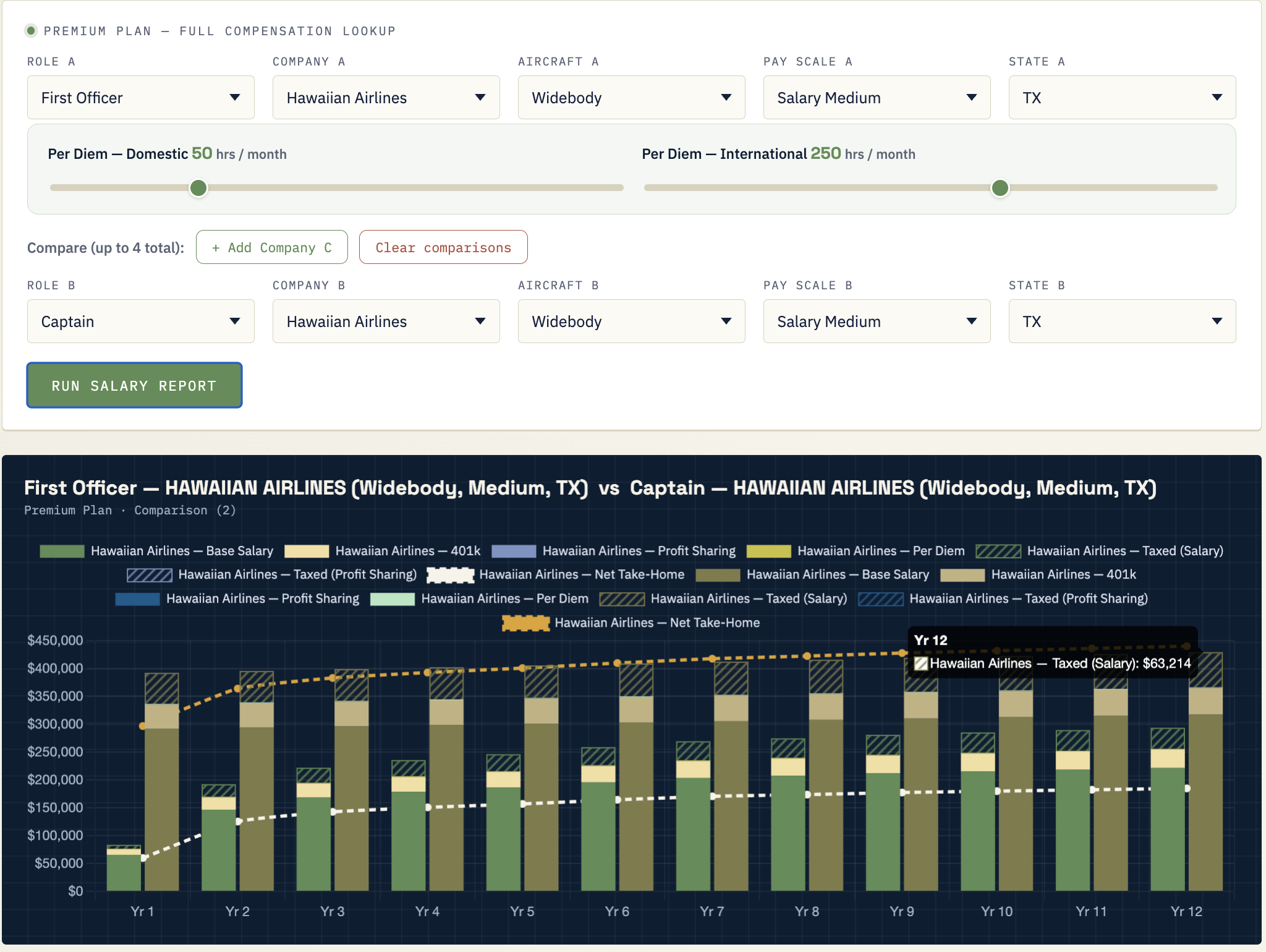
You suffer through a brutal initial pay scale when you join Hawaiian. A Year 1 First Officer clears just $58,556 in net base salary after paying roughly $6,900 in federal taxes. You survive this probationary year by living lean. See how this compares to other legacy training years in our Delta First Year Pilot Pay breakdown.
Once you break into Year 2, your wealth explodes.
First Officer Progression (Net Base Salary)
| Career Stage | Net Base Salary | Notes |
|---|---|---|
| Year 1 FO | $58,556 | Initial probationary scale |
| Year 2 FO | $124,127 | |
| Year 5 FO | $155,792 | |
| Year 8 FO | $172,556 | |
| Year 12 FO | $183,732 | After paying $37,788 in federal taxes |
You triple your take-home pay between Year 1 and Year 12. A senior First Officer clears $183,732 in pure net cash while holding maximum schedule flexibility. You out-earn almost every regional captain in the country while avoiding the stress of command.
Captain Progression (Net Base Salary)
Upgrading to the left seat unlocks the highest tax brackets in aviation. When you pin on the fourth stripe, your W-2 transforms you into an institutional investor.
| Career Stage | Net Base Salary | Notes |
|---|---|---|
| Year 1 Captain | $235,916 | After paying $55,804 in federal taxes |
| Year 2 Captain | $237,620 | |
| Year 5 Captain | $242,730 | |
| Year 8 Captain | $247,671 | |
| Year 12 Captain | $254,246 | After paying $63,214 in federal taxes |
A Year 12 Captain takes home a staggering $254,246 in liquid cash. You dictate your lifestyle, fund your personal real estate investments, and live with absolute financial freedom. You skip the regional poverty trap entirely. If you want to see exactly how much money you lose by delaying your transition to a major carrier, read our Regional vs Major Airline Decision analysis.
401k and Benefits
You build true generational wealth through your 401k. Hawaiian Airlines utilizes a massive defined contribution model. They deposit heavy cash directly into your retirement account every single month without requiring you to match a single dollar.
The retirement deposits scale aggressively alongside your base pay.
- Year 1 FO: $9,828
- Year 5 FO: $27,963
- Year 12 FO: $33,228
- Year 1 Captain: $43,758
- Year 12 Captain: $47,619
A senior captain at Hawaiian receives nearly $48,000 a year in pure retirement capital. Over a 20-year career as a captain, that direct contribution generates roughly $1,000,000 in raw cash. When you apply standard stock market compound interest, that portfolio effortlessly scales into the high seven figures.
You secure millions in long-term wealth without touching your massive base salary. While this falls slightly short of the $82,000 deposits seen at United Airlines, it remains a phenomenal wealth engine. Run your numbers through the United Pilot Pay 2026 guide to see the sheer magnitude of the legacy 401k standard.
If you want to compare this 401k accumulation against a legacy defined benefit pension, review the cargo operators. Check out our FedEx Pilot Pay 2026 and UPS Pilot Pay 2026 breakdowns. You must choose between the massive 401k deposits of the passenger world and the fixed retirement income of heavy freight.
Honolulu Base Reality
Your base assignment dictates your quality of life more than any other factor in aviation. Hawaiian Airlines anchors its global network in Honolulu (HNL).
You must live in base to survive this career. Commuting to Hawaii from the mainland destroys your physical health and your marriage. You lose entire days of your life sitting in jumpseats over the Pacific Ocean. When you fly an inter-island schedule, you work early mornings and finish in the afternoon. If you live on Oahu, you drive home and eat dinner with your family. If you commute, you head to a crash pad.
Hawaii carries a notorious cost of living. Real estate prices in Honolulu rank among the highest in the nation. The state levies heavy income taxes. Our models use a Texas resident baseline to show pure federal take-home pay, but if you live in Hawaii, you must deduct the state's aggressive tax burden from your $254,000 base salary.
You pay a premium to live in paradise. The pilots who thrive at Hawaiian embrace the island lifestyle. They surf, they avoid the mainland winter, and they accept the higher cost of goods. If you view Honolulu purely as a financial equation, you will likely leave for a mainland legacy carrier.
Career Progression Post-Merger
The Alaska Airlines acquisition of Hawaiian Airlines rewrites the career progression playbook.
Prior to the merger, Hawaiian operated as an isolated, highly specialized carrier. You flew Boeing 717s between the islands or you flew heavy Airbus A330s to the mainland and Asia. The merger integrates Hawaiian into the massive Alaska Airlines domestic network.
This creates unprecedented opportunities. You gain access to a vastly expanded route structure. The combined seniority lists will dictate how quickly you can move between the legacy Alaska Boeing 737 narrowbody fleets and the legacy Hawaiian widebody aircraft.
You command heavy metal much faster at a carrier like Hawaiian than you do at a legacy giant. You don't wait fifteen years to touch a widebody jet. As the networks merge, smart pilots will weaponize the new bidding systems to maximize their W-2 cash flow while maintaining island-based schedules.
If you grow tired of the commercial airline grind entirely, you can always explore the corporate sector. Read our NetJets vs Airline Pilot Career analysis to see how private aviation compares to the LCC and major markets.
Hawaiian vs Alaska Comparison
The merger makes the direct financial comparison between Alaska and Hawaiian critical.
- Hawaiian: A Year 12 Midsize Captain generates $303,065 in total compensation ($254,246 net base + $47,619 401k + $1,200 per diem).
- Alaska: A Year 11 Captain generates $315,570 in total compensation ($253,567 net base + $53,273 401k + $8,730 per diem).
The base salaries sit in a virtual dead heat. The $12,000 total compensation gap exists almost entirely because Alaska pilots generate higher per diem on mainland routes and receive a slightly higher 401k contribution.
The contracts mirror each other closely. Your decision no longer revolves around the hourly rate. You must decide where you want to live. If you want to base in Seattle or Anchorage, you target the legacy Alaska routes. If you want to live in Honolulu and fly heavy metal across the Pacific, you target the Hawaiian side of the operation.
FAQ Section
Does Hawaiian Airlines pay per diem on inter-island flights?
Yes, but you generate drastically less per diem than mainland pilots. Because inter-island schedules often start and end in Honolulu on the same day, you don't accumulate the massive overnight per diem hours seen at legacy carriers. This keeps your untaxed per diem yield around $1,200 annually.
Is Year 1 pay really that low?
Yes. A Year 1 First Officer nets roughly $58,556 after federal taxes. You must budget aggressively for your first twelve months on the property. Your pay triples in Year 2, but that initial probationary year requires strict financial discipline, especially if you live in Honolulu.
How does the Alaska merger affect my seniority?
Union integration committees negotiate the merging of seniority lists. While the exact mechanics depend on the final arbitrated agreements, the combined carrier offers a much larger fleet and vastly expanded upgrade opportunities across both narrowbody and widebody categories.
Should I commute to Honolulu from the mainland?
No. Commuting over the Pacific Ocean is universally regarded as one of the most grueling commutes in the industry. Live in base.
Make your decision using raw data. Compare your exact age, seniority expectations, and equipment goals side-by-side using the tools at skylevels.fyi today.