United vs Delta Pilot Pay: Which Airline Pays More in 2026?
When it comes to legacy carriers, Delta Air Lines and United Airlines represent the pinnacle of commercial aviation careers. For pilots actively deciding between offers or planning their long-term career trajectories, the choice often comes down to the numbers. While hourly rates and marketing materials might look similar on paper, a deep dive into actual take-home pay, 401k contributions, and profit-sharing reveals significant structural differences in how each airline compensates its aviators.
In this guide, we break down the hard data for a Widebody Captain living in Texas to show you exactly how these compensation packages stack up.
The Quick Answer
If you are looking for the absolute highest guaranteed base salary and massive direct 401k contributions, United Airlines pulls ahead in our 2026 Widebody Captain modeling. However, Delta Air Lines maintains an incredibly competitive package by relying on its historically strong profit-sharing program.
Let’s look at a quick snapshot of a Widebody Captain residing in Texas at Year 5 and Year 12:
| Metric (Widebody Captain, TX) | United (Year 5) | Delta (Year 5) | United (Year 12) | Delta (Year 12) |
|---|---|---|---|---|
| Base Salary (After Taxes) | $356,466 | $271,799 | $374,444 | $285,280 |
| 401k Contribution | $77,928 | $58,446 | $82,236 | $61,676 |
| Profit Sharing (After Taxes) | $0 | $25,705 | $0 | $26,940 |
| Per Diem | $12,090 | $11,610 | $12,090 | $11,610 |
Your ultimate decision depends on your priorities: Do you prefer the guaranteed base pay of United, or do you want to bank on Delta's profit-sharing checks? You can run your own numbers and compare Delta vs United pilot pay directly using our dynamic tool.
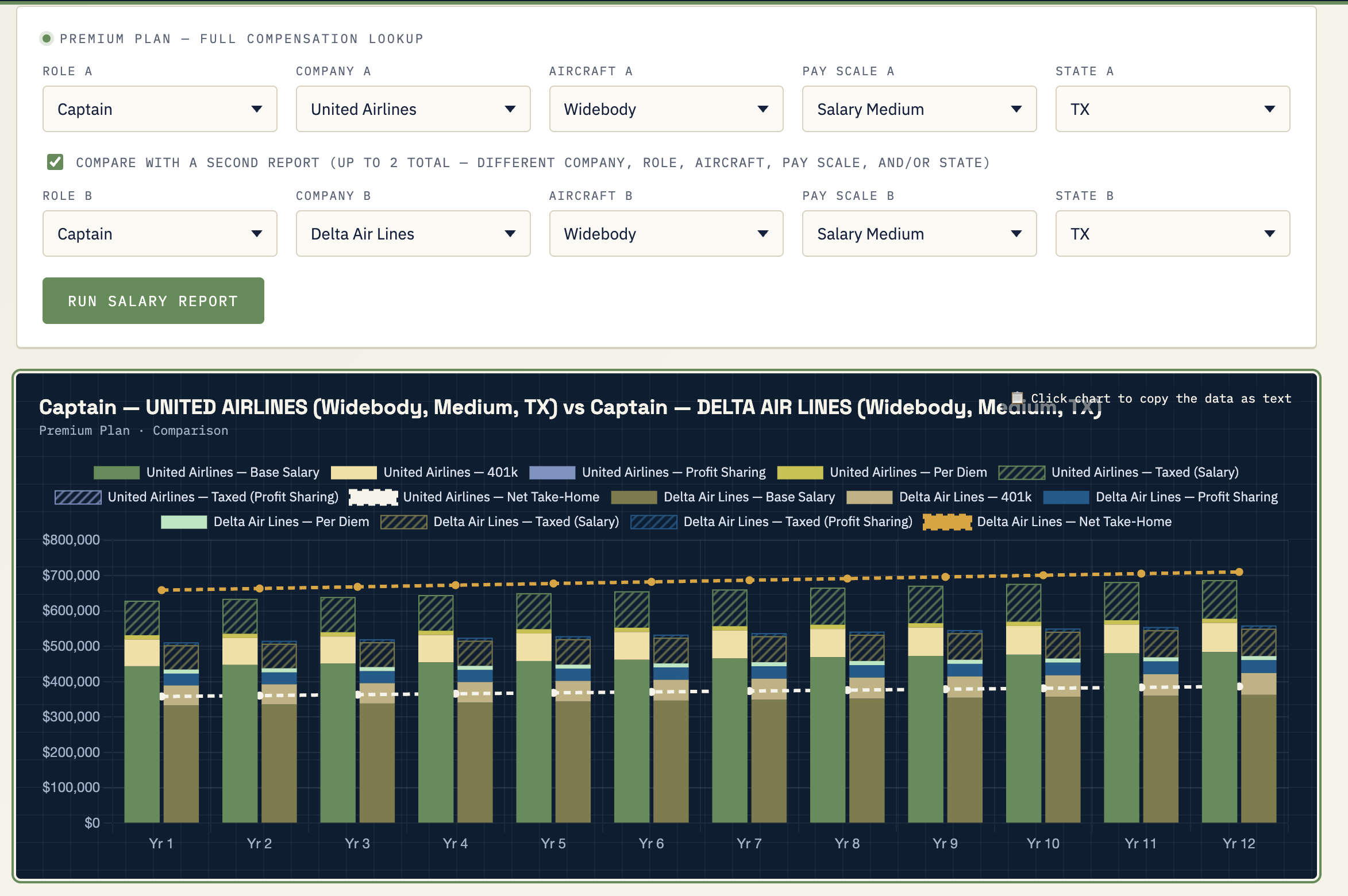 Winner: United for Guaranteed Base Pay, Delta for Profit Sharing
Base Pay Comparison
Base pay is the foundation of your financial planning. To give you the most accurate picture, we analyzed the 2026 take-home pay for Widebody Captains based in a zero-state-income-tax state (Texas), accounting for standard tax deductions.
Year 1 Captain Comparison
Stepping into the left seat of a widebody aircraft is a major milestone. At United Airlines, a Year 1 Widebody Captain sees an impressive after-tax base salary of $346,142 (with $97,708 taxed from the gross base). At Delta Air Lines, a Year 1 Widebody Captain takes home a base of $264,062 after taxes (with $68,834 taxed from the gross base). For those just starting out at the company, understanding Delta first-year pilot pay is critical to setting financial expectations early in your career.
Year 5 Captain Comparison
By Year 5, longevity pay scales kick in. A United Captain’s after-tax base salary grows to $356,466, while a Delta Captain’s after-tax base climbs to $271,799. Per diem remains relatively stable, with United paying out $12,090 annually and Delta providing $11,610.
Year 12 Captain Comparison
At the top end of our 12-year model, the base pay gap remains consistent. A 12-year United Widebody Captain brings home $374,444 after taxes, paying $109,296 in base taxes. A 12-year Delta Captain takes home $285,280 after taxes, paying $77,521 in base taxes.
Widebody Captain Compensation Table (Texas Resident)
| Experience Level | Airline | Base Salary (After Taxes) | Base Tax Paid | Per Diem |
|---|---|---|---|---|
| Year 1 | United | $346,142 | $97,708 | $12,090 |
| Year 1 | Delta | $264,062 | $68,834 | $11,610 |
| Year 6 | United | $359,020 | $102,980 | $12,090 |
| Year 6 | Delta | $273,714 | $72,785 | $11,610 |
| Year 10 | United | $369,286 | $107,184 | $12,090 |
| Year 10 | Delta | $281,417 | $75,940 | $11,610 |
While United’s base pay outpaces Delta's in this specific widebody scenario, it is vital to remember that base salary is only one part of the equation. To view all fleet types and seats, read our Complete Guide to Delta Air Lines Pilot Pay in 2026.
Winner: United Airlines
Retirement and 401k Deep Dive
The true wealth-building engine for airline pilots is the 401k direct contribution. Both Delta and United offer industry-leading retirement benefits, contributing 16% and 17% respectively, without requiring an employee match.
Because 401k contributions are calculated as a percentage of your total eligible compensation, United’s higher gross base salaries in our model yield massive retirement deposits.
- A Year 1 United Captain receives a $75,455 401k contribution.
- By Year 12, that United 401k contribution swells to $82,236 annually.
Delta's retirement contributions are also exceptional, though mathematically lower due to the base pay differences in this model.
- A Year 1 Delta Captain sees a $56,592 401k contribution.
- By Year 12, Delta contributes $61,676 annually to the pilot's 401k.
The Profit-Sharing Factor
This is where Delta aggressively closes the total compensation gap. Delta has historically possessed the most lucrative profit-sharing program in the airline industry. In our modeling for a Texas resident:
- A Year 1 Delta Captain takes home $24,996 in after-tax profit sharing (with $8,293 taxed from the gross amount).
- By Year 12, this grows to $26,940 in after-tax profit sharing (with $9,340 taxed).
United Airlines pilots also have a profit-sharing program (historically lower than Delta's), but depending on corporate performance and specific contract cycles, modeling often conservatively projects this at $0 to avoid over-promising variable income, as reflected in our data.
Winner: Tie (United dominates direct 401k volume, while Delta dominates Profit Sharing payouts).
Benefits and Network
Total compensation isn't just about the money hitting your bank account; quality of life, base choices, and travel benefits play massive roles in a 30-year career.
Base Cities:
Where you live versus where you are based determines your commuting stress.
- Delta dominates the Southeast and Midwest with massive hubs in Atlanta (ATL), Detroit (DTW), Minneapolis (MSP), and Salt Lake City (SLC), alongside coastal hubs in NY and LA.
- United provides a dominant West Coast and Central presence with hubs in San Francisco (SFO), Denver (DEN), Chicago (ORD), Houston (IAH), Newark (EWR), and Washington Dulles (IAD).
If you live in Houston, United is a natural choice. If you live in Atlanta, Delta is the obvious winner.
Network and Upgrades:
Both airlines operate massive, diverse fleets. United has leaned heavily into large international widebody orders, which can accelerate upgrade times into the right seat of a Boeing 777 or 787. Delta operates a highly mixed fleet of Airbus and Boeing aircraft, providing distinct category paths.
For pilots comparing legacy carriers to other industry sectors, the choices expand. If you are comparing passenger widebody flying against cargo, we recommend reviewing United Airlines vs UPS Airlines Pilot Pay. If you are currently at a regional airline and mapping your legacy career, check out SkyWest Airlines vs United Airlines Pilot Pay. Lastly, if you are weighing a legacy carrier against a premium national carrier, Alaska Airlines vs United Airlines Pilot Pay provides excellent comparative data.
Winner: Subjective (Depends entirely on your home city and preferred aircraft).
Which Should You Choose?
Deciding between United and Delta is a "good problem to have." Both offer top-tier compensation packages that place you in the top 1% of earners in the United States.
Choose United Airlines if:
- You prioritize guaranteed, high base salaries over variable profit-sharing.
- You want to maximize direct 401k contributions.
- You live in or plan to move to a United hub like Denver, Houston, or San Francisco.
Choose Delta Air Lines if:
- You want to capitalize on the industry's strongest historical profit-sharing program.
- You live in the Southeast or Midwest (Atlanta, Detroit, Minneapolis).
- You prefer the culture and specific fleet composition of Delta.
To make the best choice for your personal situation, don't rely on generic advice. Head over to skylevels.fyi and use our interactive modeling tools to project your exact career path.
FAQ Section
Which pays more overall? It depends on how you factor in profit sharing. United offers higher guaranteed base salaries and massive 401k contributions for Widebody Captains. Delta offsets its lower base pay with substantial, consistent profit-sharing checks that can total tens of thousands of dollars annually.
Is Delta really better than United? Culturally, employees of both airlines will defend their companies fiercely. Objective data shows that neither is strictly "better"—they just structure their compensation differently. Delta leans on performance-based bonuses (profit sharing), while United currently scales higher on guaranteed widebody hourly rates and direct retirement volume.
Which has faster upgrade times? Upgrade times fluctuate based on aircraft orders and pilot retirements. United's massive widebody aircraft orders have historically created rapid advancement opportunities, but Delta's continuous fleet renewal also provides excellent movement.
Which has better travel benefits? Both airlines offer excellent non-revenue travel benefits on massive global networks. Your experience will largely depend on which airline has more direct flights out of your home airport.
Should I take an offer from either now? Yes. Seniority is everything in aviation. If you receive a conditional job offer (CJO) from either Delta or United, the standard industry advice is to accept it immediately to lock in your seniority number.
Conclusion
The 2026 data reveals two distinct compensation philosophies. United Airlines leads in pure, guaranteed base pay and the resulting 401k volume, ensuring that your financial foundation is rock solid regardless of the broader economic climate. Delta Air Lines, conversely, treats its pilots as true stakeholders, offering lower base rates but bridging the gap with an aggressive, lucrative profit-sharing program.
Ultimately, you cannot make a wrong financial choice between these two legacy giants. The deciding factor should be your quality of life, which is heavily dictated by base location and fleet preference.
Don't leave your career planning to guesswork. Compare your specific scenario, seat, and base location today at skylevels.fyi.