Complete Guide to Charter and Cargo Feeder Airlines: USA Jet Analysis
USA Jet Airlines captains earn $171,531 total compensation at Year 12 flying regular narrowbodies. That's less than major carriers but represents a legitimate career path many pilots dismiss too quickly. Here's the complete analysis of charter cargo feeder careers.
Most student pilots map out their careers using a rigid, identical template. You instruct for 1,500 hours, you fly for a regional airline like Envoy or SkyWest, and you beg a legacy carrier for a class date. You assume passenger flying represents the only viable path to six-figure wealth.
You ignore a massive, quiet sector of the aviation economy.
Ad-hoc charter and cargo feeder airlines keep the global supply chain from collapsing. Carriers like USA Jet Airlines operate in the shadows. They fly unscheduled freight, moving automotive parts, hazardous materials, and critical manufacturing components at a moment's notice. They do not publish schedules months in advance. They wait for the phone to ring, they load the jets, and they fly.
We pulled the exact, tax-adjusted data from the skylevels.fyi database to expose the real numbers behind this alternative career path. We modeled the data for a Texas resident to eliminate state income tax noise and show you exactly what hits your checking account. This analysis strips away the mystery surrounding the ad-hoc cargo sector. We will break down the exact earning power of USA Jet Airlines so you can determine if the on-demand freight lifestyle fits your career strategy.
Map Your Trajectory: Stop guessing about your earning power. Model your exact career timeline using the skylevels.fyi comparison tools to see how this specific scenario stacks up against passenger and regional operations.
What Charter Cargo Feeders Do
You must understand the business model before you evaluate the paycheck. USA Jet Airlines does not compete with Delta or United. They do not even compete directly with FedEx or UPS.
Heavy freight operators like FedEx run massive, scheduled global networks. They route thousands of packages through superhubs every single night. Compare that massive logistical footprint in our FedEx Pilot Pay 2026 and UPS Pilot Pay 2026 guides.
USA Jet Airlines operates "just-in-time" freight. When a massive automotive plant in Detroit realizes they will run out of steering wheels in six hours, they face millions of dollars in losses if the assembly line stops. They call an ad-hoc charter company. USA Jet dispatches a narrowbody jet to a factory in Mexico, loads the parts, and flies them directly to Michigan to save the production line.
You fly when the client needs you. You do not hold a predictable monthly schedule. You sit on call, monitoring your phone. When dispatch calls, you head to the airport.
You trade predictability for pure operational flying. You fly into obscure airports. You operate older, robust aircraft like McDonnell Douglas MD-80s or converted business jets. You never deal with a single complaining passenger. You load the boxes, close the door, and get the job done. This environment breeds incredible aviators who know how to manage severe weather, complex mechanical issues, and dynamic routing without relying on massive airline infrastructure.
USA Jet Pay Breakdown
Let's look at the actual cash. We modeled these numbers for a pilot residing in a tax-free state to isolate the sheer earning power of the USA Jet contract after the IRS extracts federal taxes.
USA Jet splits its pay scales based on the equipment you fly. You earn vastly different money flying a business jet compared to a regular narrowbody aircraft.
First Officer Progression
You enter USA Jet Airlines on a modest pay scale. The company suppresses first-year pay to offset the massive cost of training you on specialized aircraft.
Business Jet First Officer
| Year | Total Compensation | Net Base | 401k Contribution | Per Diem |
|---|---|---|---|---|
| Year 1 | $62,317 | $58,777 | $2,040 | $1,500 |
| Year 4 | $67,216 | $63,496 | $2,220 | $1,500 |
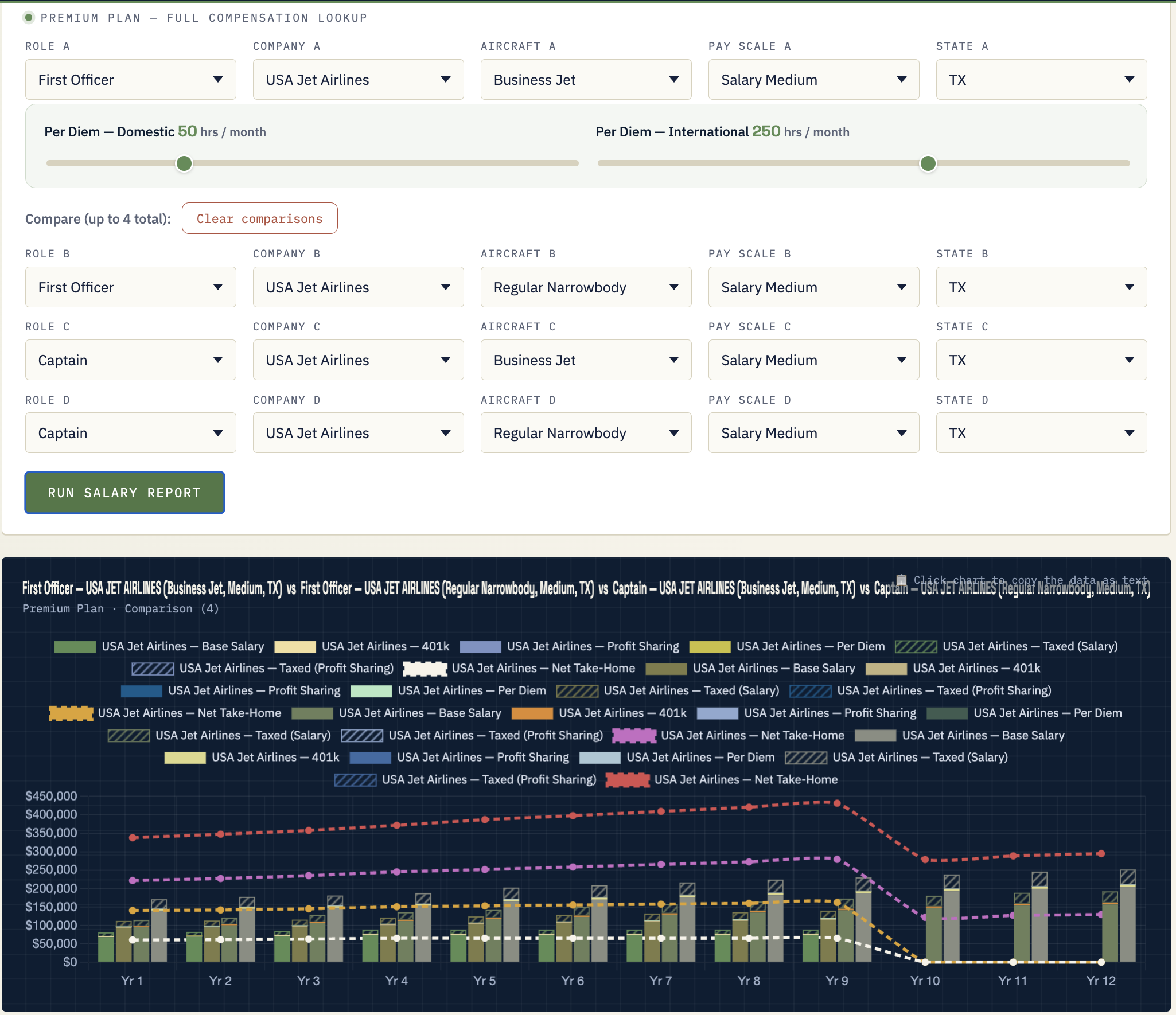
Our data shows a hard cap for Business Jet First Officers hitting at Year 4 and locking in through Year 9, followed by zeros. The company forces you to upgrade. They do not want you sitting in the right seat of a small jet for a decade.
Regular Narrowbody First Officer (e.g., MD-80)
| Year | Total Compensation | Net Base | 401k Contribution | Per Diem |
|---|---|---|---|---|
| Year 1 | $82,732 | $78,442 | $2,790 | $1,500 |
| Year 5 | $90,898 | $86,308 | $3,090 | $1,500 |
| Year 9 | $100,580 | $95,630 | $3,450 | $1,500 |
The narrowbody FO scale caps out at Year 9. Again, you must upgrade or leave.
Captain Progression
Upgrading to the left seat pushes you into six-figure territory permanently.
Business Jet Captain
| Year | Total Compensation | Net Base | 401k Contribution | Per Diem |
|---|---|---|---|---|
| Year 1 | $84,365 | $80,015 | $2,850 | $1,500 |
| Year 6 | $106,958 | $101,768 | $3,690 | $1,500 |
| Year 12 | $134,062 | $127,852 | $4,710 | $1,500 |
If you command a Regular Narrowbody, you reach the absolute pinnacle of the USA Jet pay scale:
Regular Narrowbody Captain
| Year | Total Compensation | Net Base | 401k Contribution | Per Diem |
|---|---|---|---|---|
| Year 1 | $120,510 | $114,810 | $4,200 | $1,500 |
| Year 5 | $140,440 | $133,990 | $4,950 | $1,500 |
| Year 12 | $171,531 | $163,911 | $6,120 | $1,500 |
A Year 12 Narrowbody Captain clears $171,531. You earn a highly respectable living. You fund your life, buy a house, and operate massive aircraft without ever touching a passenger terminal. But you must recognize the structural limits of this specific contract.
Look at the 401k contributions. A senior captain receives just $6,120 in company 401k deposits. The company does not fund your retirement. You must take your net base salary and invest it yourself. Compare this raw dynamic against the massive $60,000+ retirement drops seen at the major carriers in our United Pilot Pay 2026 and Complete Guide to Delta Air Lines Pilot Pay in 2026 analyses.
Career Progression at Feeders
You upgrade fast in the ad-hoc cargo world.
Passenger airlines rely on massive, stagnant seniority lists. You wait years for the pilot ahead of you to retire before you can bid for the left seat. Ad-hoc feeders operate with intense turnover. Pilots constantly use USA Jet as a stepping stone to reach FedEx, UPS, or a legacy carrier.
This turnover works to your massive advantage. When the pilot above you leaves for Delta, you slide into their seat. You bounce from Business Jet First Officer to Narrowbody First Officer, and then straight into the left seat of a command aircraft. You log invaluable Part 121 or Part 135 Pilot-in-Command (PIC) time at an astonishing rate.
Major airlines respect ad-hoc cargo pilots. They know you fly broken airplanes through terrible weather at 3:00 AM into airports with no radar coverage. You build a resume built on pure airmanship.
You must map out your exit strategy early. Do not get comfortable. You bleed millions of dollars in generational wealth if you sit in the left seat of an MD-80 for twenty years instead of moving to a legacy carrier. See exactly how much cash you leave on the table by reading our Regional vs Major Airline Decision guide. The financial logic applied to regional airlines applies directly to cargo feeders.
Feeder vs Regional Airline Comparison
How does USA Jet stack up against a premier passenger regional airline?
| Role (Year 12 Captain) | Total Annual Compensation |
|---|---|
| SkyWest Airlines | $172,031 |
| USA Jet (Narrowbody) | $171,531 |
The top-end pay scales mirror each other almost exactly. You face a $500 difference in pure annual yield. The choice between these two paths comes down entirely to the lifestyle you want to live while you build your hours.
Do you want to fly clean, modern Embraer 175s on scheduled domestic routes? Do you want to wear a crisp uniform, walk through passenger terminals, and operate under the massive umbrella of a Delta or United partnership? If so, you go to a regional. Read the exact math behind that path in our Best Regional Airlines and LCCs for Pilots in 2026 guide.
Or do you hate passengers? Do you want to wear a polo shirt, load freight in the middle of the night, and fly aggressive, unpredictable missions? Do you want to log time in heavy classic metal? If you prefer the grit of actual stick-and-rudder aviation, you go to a cargo feeder.
If you want to see how these mid-tier jobs compare to the massive domestic LCC market, run your numbers through the Envoy Air vs Southwest Airlines Pilot Pay and American Airlines vs Southwest Airlines Pilot Pay tools.
When Feeder Makes Sense
The ad-hoc cargo feeder path makes perfect sense under three specific conditions:
- You live near the base: USA Jet anchors its operation in Willow Run (YIP) near Detroit, Michigan. If you live in Michigan, you drive to work. You never suffer the horrors of jumpseat commuting. You sit on your couch while on reserve, and you drive to the airport when the pager goes off.
- Your goal involves heavy global freight: If you want to fly the Boeing 777 for FedEx or UPS, flying narrowbody cargo jets for a feeder provides the exact resume experience those companies demand. Check out the FedEx Express vs Southwest Airlines Pilot Pay and Southwest Airlines vs UPS Airlines Pilot Pay comparisons to see the wealth waiting for you at the top of the cargo food chain.
- You want an alternative legacy path: If you hold a slightly marred training record or struggled in a highly structured regional airline environment, ad-hoc cargo provides a second chance. You prove your worth by operating in the most demanding flight environments in the country. You log 1,000 hours of heavy PIC time, scrub your resume, and secure your legacy class date.
See how this alternative path aligns with massive domestic success by reviewing the Delta Air Lines vs Southwest Airlines Pilot Pay and Southwest Airlines vs United Airlines Pilot Pay metrics.
FAQ
Does USA Jet Airlines pay per diem? Yes. Our data models a flat $1,500 annual per diem rate across all seniority levels and equipment types. This covers your basic meals and incidentals while sitting in hotels waiting for cargo missions. It falls vastly short of the $12,000+ per diem generated at major carriers.
Is flying ad-hoc charter dangerous? It demands higher situational awareness. You fly into unfamiliar airports, often at night, in dynamic weather conditions. You do not have the massive dispatch and maintenance support structures found at Delta or United. It creates incredible pilots, but it punishes complacency.
How do cargo feeder 401k plans compare to the industry? They rank near the bottom. A top-tier USA Jet captain receives just $6,120 in company 401k deposits. Legacy passenger carriers drop $60,000 to $80,000 annually. You must manually invest your base salary to survive retirement.
Can I jump straight from a cargo feeder to a legacy airline? Absolutely. Legacy airlines highly value the stick-and-rudder skills and command authority developed in the ad-hoc cargo sector. Get your 1,000 hours of PIC time and update your applications aggressively. Compare your domestic options today using the Alaska Airlines vs Southwest Airlines Pilot Pay tool.
The Bottom Line
A $171,531 total compensation package at USA Jet Airlines mirrors the regional passenger market perfectly. You face the exact same career limitations.
Do not get comfortable. You use the ad-hoc cargo sector to build your logbook, sharpen your airmanship, and prove your command authority. You fly the heavy iron, master the night schedule, and then you leave. Every single year you linger at a cargo feeder costs you hundreds of thousands of dollars in unrecoverable major airline 401k contributions.
If you want to escape the passenger terminals and fly pure freight, use USA Jet as your launching pad. Build your resume, check out the Emirates Pilot Pay 2026 and Hawaiian Airlines Pilot Pay 2026 guides to expand your global horizons, and map your escape route using the interactive comparison tools at skylevels.fyi.